
Who Says Pre-K Assessments Have to Be Scary?
Reimagining Children’s Experiences During Direct Assessments


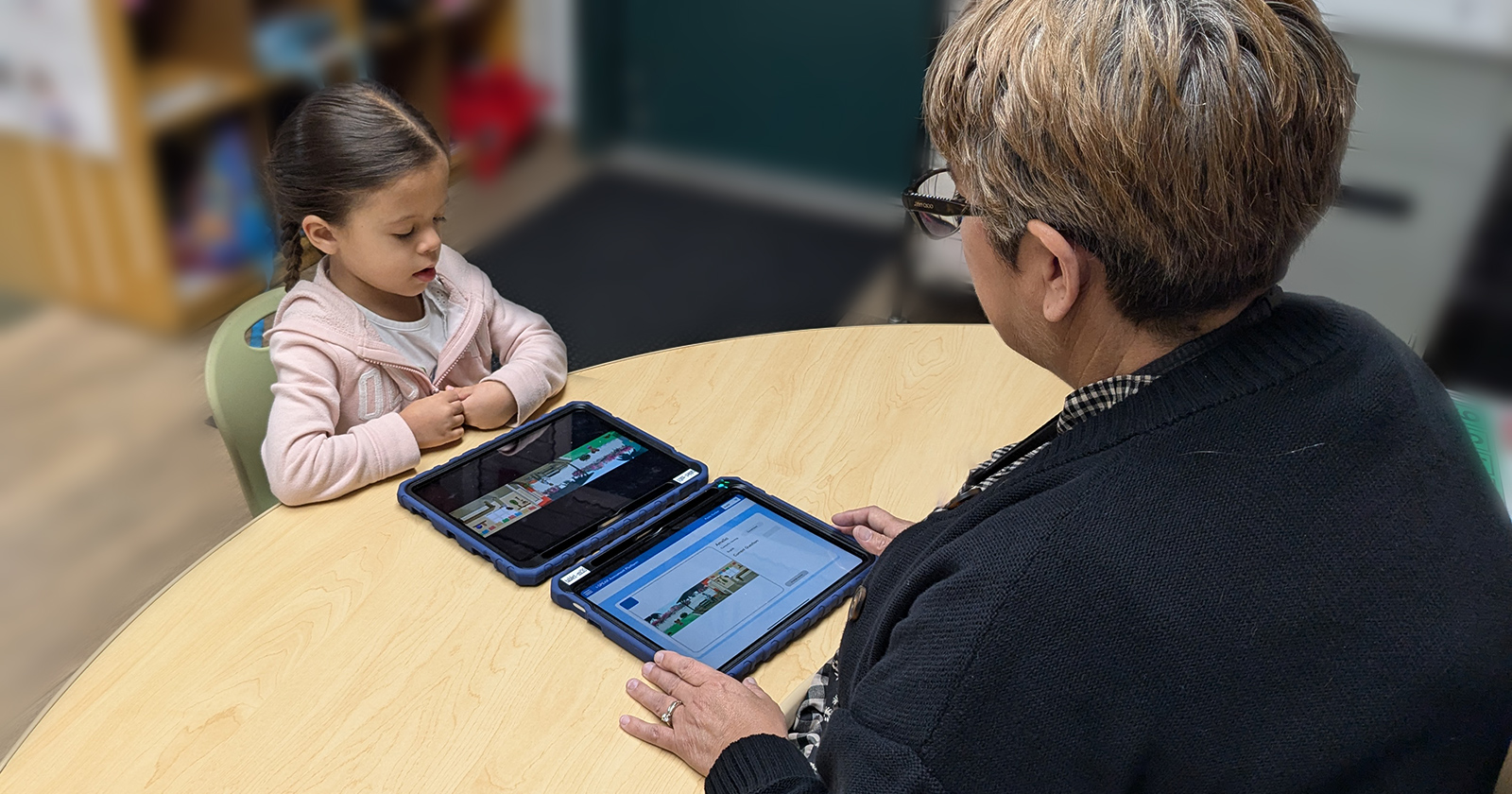
Direct assessments of young learners offer important information that informs the work of educators and caregivers. In this approach, children complete tasks or answer questions that show how they are performing relative to typical developmental expectations for children their age.[1] Educators and caregivers rely on these insights to know how to support individual children and plan instruction in pre-K classrooms.
While direct assessments produce useful data, collecting these data can often be burdensome for educators and children. Direct assessments are typically conducted in one-on-one sessions. For young learners, this experience in the spotlight can feel uncomfortable or stressful, especially when assessments are lengthy or have repetitive prompts.[2] Children’s experiences taking assessments could affect their performance and the quality of data the assessments produce.[3] That is, scores may reflect children’s comfort with the assessment format and not their true skills in the assessed areas.
MDRC’s Measures for Early Success Initiative (or Measures Initiative) aims to develop novel direct assessments for preschoolers through a process in which assessment developers and users (namely, pre-K educators, families, and children) codesign assessments. Over the last two years, MDRC has connected eight assessment-development teams with over 500 early educators and caregivers and 1,500 pre-K children across the United States to develop inventive direct assessment approaches. Through a variety of research activities (including focus groups, interviews, and pilot testing in real pre-K classrooms), users have given developers valuable information to guide assessment developments. This issue focus presents lessons on how to make children’s experiences a priority when conducting direct assessments.
Embedding gamelike elements in assessments makes them part of a playful pre-K experience.
Digital assessments that measure children’s skills as they play games—or game-based assessments—are increasingly common in K-12 education.[4] This type of assessment is hypothesized to increase student engagement and yield data that more accurately reflect children’s skills than traditional assessment tasks.[5] Several of the Measures Initiative teams are investigating whether game-based approaches might be an effective approach to capturing the skills of younger learners in pre-K.
One of these teams, Khan Academy Kids (Khan), is building on its existing digital library of over 5,000 learning activities for children ages 2 to 8 by developing a series of three- to five-minute, gamelike activities to assess young children’s skills. These tablet-based activities (available in both English and Spanish) align with specific early learning standards from the Head Start Early Learning Outcomes Framework and from various states.[6] For example, one Khan math assessment activity focuses on capturing children’s ability to recognize, extend, and create patterns, a foundational math reasoning skill. Children are asked to complete, replicate, and create patterns using colorful digital objects such as monsters that make silly sounds as children move them.
In fall 2024, Khan pilot tested its tool with 297 children in 20 pre-K classrooms. Insights from educator surveys, classroom observations, and focus groups suggest that children found these activities highly engaging. Over 80 percent of educators reported that the children in their classrooms “enjoyed and had fun” using the tool. Over the course of just nine weeks, participating children completed a total of 3,112 Khan Academy Kids assessment activities. Children’s enthusiasm for and continued engagement with these activities show that short, gamelike tasks are a promising way to measure children’s skills across a range of learning domains without sacrificing the playfulness of typical pre-K environments.
Connecting assessment elements to children’s personal experiences boosts engagement.
Measures Initiative teams are exploring ways to increase children’s engagement by drawing on their personal experiences during assessments. Some teams, such as Khan Academy Kids, integrate everyday objects and real-life scenarios into assessment tasks. For example, rather than use generic objects such as math manipulatives (items manipulated in instruction, for example blocks and shape tiles) to evaluate children’s understanding of ordinal words like “first,” “second,” and “third,” the Khan team gives children the chance to demonstrate this skill in scenarios such as identifying the order of characters waiting in line at an ice cream cart; children are asked to identify characters in specific places in line (for example, “who is first in line?”).
Another developer team—I-SPEAK, comprising partners from the University of Minnesota, Aviellah Curriculum and Consulting, the University of Oregon, and FableVision Studios—has adopted a more comprehensive approach, situating assessment tasks within digital stories. The I-SPEAK team collaborates with a community insights consortium—which represents perspectives from across the United States—to develop stories. In one I-SPEAK story, children have the chance to help prepare for their grandmother’s birthday party. This story is available in English and Spanish; the Spanish version is further differentiated into Mexican and Puerto Rican dialects. As children navigate through Grandma’s house on their tablets, they are asked to complete several tasks and respond to prompts that measure their language, literacy, and math skills and reflect activities they might do in real life. These activities could include selecting ingredients for a special birthday treat—based on initial letter sounds (literacy)—or combining the ingredients with the right number of stirs (numeracy).
In fall 2024, the I-SPEAK team pilot tested its assessment approach with 304 children across 19 classrooms. Insights from research activities during this pilot test suggest that building opportunities for connection using these types of stories is not only fun for students, but also allows children to draw on knowledge from their own lives as they complete assessment tasks. In a survey following the pilot test, 94 percent of educators said that children in their classrooms indicated their familiarity with the assessment scenarios by saying things like, “I’ve been there,” “This looks like my grandma’s house,” or “I have a dog.” In observations of the classrooms conducted during the pilot test, 85 percent of children were observed to be engaged with the assessment, as indicated by their sustained engagement during most or all of the observation period.
Designing direct assessments for use during typical pre-K activities helps children approach assessments with confidence.
Measures Initiative teams have worked closely with educators to design tools that can be seamlessly integrated into pre-K classrooms. Children in pre-K classrooms learn in a variety of formats, such as whole-group circle time, small groups, and free play or learning centers.[7] In traditional direct assessments, children are often pulled out of their activities to work one-on-one with an educator or other trained assessor. Assessment developers are thinking about how technological advancements make it possible to fit direct assessments into daily pre-K routines—not only to reduce educator burden, but also to make assessments feel more like everyday learning activities than high-stakes, unfamiliar events for children.[8] Integrating assessments into regular classroom activities allows children to put their best foot forward and complete assessments with confidence, rather than approaching them with the stress of an unfamiliar situation.[9] Fall 2024 pilot test data indicate that teachers can implement both the Khan Academy Kids and I-SPEAK assessments confidently. Across both tools, roughly 80 percent of teachers could implement the assessments in a variety of learning formats, particularly in small groups and learning centers.
Don’t forget the kids! Keep children at the center of assessment design and development.
Assessments that are fun, reflect children’s experiences, and fit into their daily routines are hypothesized to keep children engaged and, in turn, produce more accurate information about their knowledge and skills. The Measures Initiative project teams are keeping pre-K children at the center of the assessment-design and -development process by asking children, educators, and families to help them figure out how to make the tools engaging and appropriate for young learners. They get reactions from these groups on everything from small details—such as what sounds assessment buttons make—to the big concepts, such as whether assessments that use digital games or stories are appealing. Keeping the experiences of children at the forefront of assessment development could help ensure that data reflect the true progress, growth, and joy that happens in early learning settings.
This work was funded by the Gates Foundation. The findings and conclusions contained within are those of the authors and do not necessarily reflect positions or policies of the Gates Foundation.
[1] Cathy Yun, Hanna Melnick, and Marjorie Wechsler, “High-Quality Early Childhood Assessment: Learning from States’ Use of Kindergarten Entry Assessments” (Learning Policy Institute, 2021).
[2] Rashida Banerjee and John L. Luckner, “Assessment Practices and Training Needs of Early Childhood Professionals,” Journal of Early Childhood Teacher Education 34, 3 (2012): 231–248.
[3] Emily C. Hanno, Ximena A. Portilla, and JoAnn Hsueh, “Designing Equity-Centered Early Learning Assessments for Today’s Young Children,” Child Development Perspectives 19, 2 (2024): 92–98.
[4] Organisation for Economic Co-Operation and Development, OECD Digital Education Outlook 2021: Pushing the Frontiers with Artificial Intelligence, Blockchain, and Robots (OECD Publishing, 2021).
[5] Kristen E. DiCerbo, “Game-Based Assessment of Persistence,” Educational Technology and Society 17, 1 (2014): 17–28.
[6] U.S. Department of Health and Human Services, Administration for Children and Families, “Interactive Head Start Early Learning Outcomes Framework: Ages Birth to Five” (website: https://headstart.gov/interactive-head-start-early-learning-outcomes-framework-ages-birth-five, n.d., accessed June 26, 2025).
[7] These are common instructional learning formats in pre-K classrooms. Whole-group circle time refers to times when an educator is leading most or all students in the class in a shared activity. Small groups refers to times when an educator is leading a few students in an activity. Free play or learning centers refers to times when children select activities within a variety of spaces prepared by the educator (for example, pretend play, writing, or library).
[8] Valerie Shute, Xi Lu, and Seyedahmad Rahimi, “Stealth Assessment,” in J. M. Spector (ed.), The Routledge Encyclopedia of Education (Taylor and Francis Group, 2021).
[9] National Association for the Education of Young Children, “Developmentally Appropriate Practice (DAP) Statement: Observing, Document, and Assessing Children’s Development and Learning (website: https://www.naeyc.org/resources/position-statements/dap/assessing-development, n.d., accessed on July 17, 2025).