
Improving Outcomes for Transfer Students
Transferring credits from a community college to a four-year institution remains a crucial strategy to boosting bachelor’s degree attainment and improving outcomes for graduates. But transfer students often face significant challenges to having their credits accepted and, more importantly, applied to degree requirements at four-year institutions.
Faculty members in teaching, research, and administrative positions play a pivotal role in decisions about whether and how credits transfer. Yet little is known about how they approach these decisions or what factors influence their judgment.
MDRC is working with three University of Texas System colleges to better understand how faculty members make these decisions within a large and complex transfer landscape.
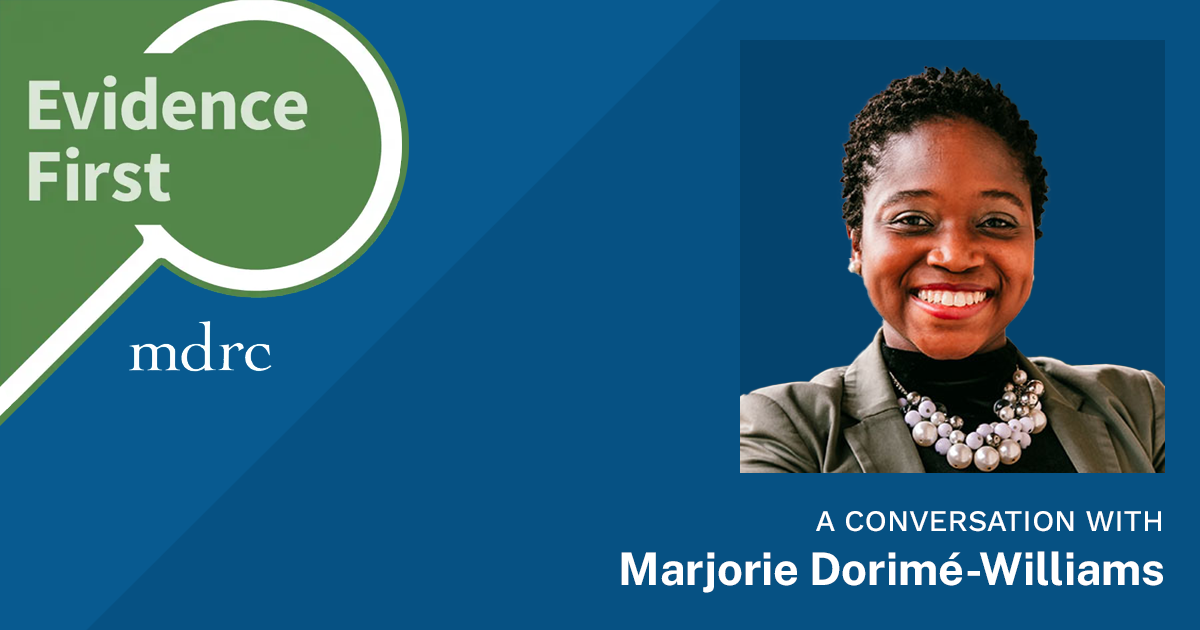
In this episode, Leigh Parise talks with Marjorie Dorimé-Williams, senior research associate at MDRC, leading the study.


View Transcript
Leigh Parise: Policymakers talk about solutions, but which ones really work? Welcome to Evidence First, a podcast from MDRC that explores the best evidence available on what works to improve the lives of people with low incomes. I'm your host, Leigh Parise.
Transferring credits from a community college to a four-year institution remains a crucial strategy to boosting bachelor's degree attainment and improving outcomes for grads. But transfer students often face significant challenges to having their credits accepted and more importantly applied to degree requirements and more importantly applied to degree requirements at four-year institutions.
Faculty members in teaching, research, and administrative positions play a pivotal role in decisions about whether and how credits transfer. Yet, little is known about how they approach these decisions or what factors influence their judgment.
MDRC is working with three University of Texas System colleges to better understand how faculty members make these decisions within a large and complex transfer landscape.
Joining me today is Marjorie Dorimé-Williams, a senior research associate at MDRC leading the study. Marjorie, welcome to Evidence First.
Marjorie Dorimé-Williams: Hi, I am so excited to be here. Thank you so much for the introduction and for choosing to feature, I think this really important work.
Parise: Yeah, it's great. I'm really excited that you get to be the one here with me to talk about it.
Okay, so Marjorie, this might seem obvious, but can you just say a little bit for listeners about why a student might want to transfer or what the potential benefits could be and what that really means?
Dorimé-Williams: Yeah, that's such a great question. And I know in our sort of thinking about post-secondary education and continuing education, what does this all mean and why do we need these things to begin with? And I actually, it's funny coming into this project, I actually had a conversation with my parents who I think are almost that idealized case in some ways. And so both of my parents attended community college in their of their early educational post-secondary career and they both earned an associate's and then were able to then transfer to a four-year institution where they were able to earn their bachelor's degrees, both of them in pharmacy, and later on were able to become independent pharmacists, and business owners, and entrepreneurs.
And so I think that understanding that the pathway in post-secondary education and understanding that, yes, an associate's and those certificates and credentials are really important in increasing, for example, earnings for folks, being able to have more options in terms of considering professional careers and outcomes. The fact is that that pathway opens up even more for those with a bachelor's degree. And so even coming into this project, talked to my parents and said, hey, I'm doing a project on transfer. And they were like, that's so important. And transfer is so important. And we wouldn't be here if not for our ability to transfer from the community college that they were at to the four-year institution that they went to where we lived. And so I think it's really important for folks to understand that really transfer is about access and making sure that students have access to options.
Ultimately, we know that college pays. We know that those with bachelor degrees have higher earnings. They have more career opportunities. They have lower unemployment rates. so really, I think it's incumbent on states and institutions to really think about how do we make this easier for our students? And how do we make this process less onerous and eliminate some of these barriers so that we can contribute to these outcomes that I think we all can agree are great, right?
Dorimé-Williams: I don't think anyone's like, no, let's raise unemployment. And so I really do hope that this work helps to inform those practices because ultimately there are things that across the board, no matter who you are, I think we can all agree are important.
Parise: Thank you very much for starting there. All right, so then now let's give people an understanding of what the journey of a transfer student may look like.
So they’re someone who completed a two-year degree and are hoping to transfer to a four-year institution. And the idea is that if their credits can be applied to the degree requirements, then they'd only have two more years to go in order to graduate with a bachelor's degree. Is that? Is that correct?
Dorimé-Williams: That is a great summary, Leigh, and I think in the most idealized sense of our understanding of transfer, yes, that's how we would like it to work. I think that's how a lot of folks think it should work. The reality is a lot more complex and messy, and I think not always as straightforward as we would like. So everything from, and in this case, we did do a lot around students transferring specifically from community colleges in the state of Texas to four-year institutions in the state of Texas. And it's just not that simple. It's not as cut and dry.
We often have one – students who look to transfer before achieving or earning their associates degrees. And so that's sort of one group of students. And then the others, like you mentioned, might complete their associate’s before looking to transfer. And both those student groups then, sort of, have a different set of considerations that they're making when looking to transfer to a four-year institution. That involves not just how many credits have I earned and what can apply to my hopefully subsequent four-year degree, but also looking specifically at the types of courses, what those courses are worth, because courses don't have the same sort of application as others. And so there's a lot of, I think, nuance to what this looks like when students are transferring. And then for four-year institutions in particular, the level of scrutiny that they're sort of having to engage in is also going to differ depending on the types of courses that students are bringing in.
Parise: Great. So tell us a little bit more. What does it actually mean then for your credits to be accepted versus applied to a degree requirement? Like, how does all of this actually play out at the institution where I may be trying to transfer?
Dorimé-Williams: That is such a great question. And probably one of the very first things that we realized pretty quickly on in this project was that we needed to have a common understanding of vocabulary to talk about credit transfer and what it means and what we're referring to. In the state of Texas in particular, the legislature has done a lot of work to help streamline this process, to think about students going from two-year institutions to four-year institutions, thinking about things like what types of courses should credit be given for and sort of what kinds of courses students should automatically be given credit for.
And so, one of the things that we understood and learned as we were engaging with not just faculty but also administrators across the system and at our partner institutions was that credits that are, let's say, legislatively required to transfer, for example, so a student can take a math course and if it's a part of sort of this list of courses, then what it says is the three credits that the student earned at a community college, for example, will transfer as three credits for a math course at whatever four year institution they might be enrolled in. What we learned was that that's only sort of the first step in the process. And for most students, this is not an issue, right? Most of these courses, the credits transfer, it's not an issue, there aren't a whole lot of questions.
But in some cases, although those credits are transferred, how that then maps to somebody's specific degree requirement, so the things that they need to take for graduation or what they're getting credit for towards their graduation, that's sort of where I would say the fun starts or where some of the challenges show up in the process because that is not often as, it's certainly not as legislated, it's not as cut and dry in some cases.
And particularly as students start to take more upper level courses, then there's less structure and legislation that sort of dictates, yes, this course transfers, you get credit for it, and it applies towards your degree in, I used a math course, so let's just say mathematics. Instead, what credit applicability speaks to is, yes, that students get credit for the course and that it applies towards their degree requirements so that they can then graduate in a timely manner. So again, that story of you take your two years at a community college and then two years at a four year and you're done doesn't always play out that way because sometimes what happens is students will take those courses at a community college, for example, and then look to transfer. And unfortunately, sure, we can give you three credits for that, but it's only an elective. And so they're having to take some of these courses again.
Parise: Well, that sounds probably much more complicated than the students who are looking to do the transferring would hope it would be. And I imagine that it's got to be a pretty big deterrent to actually completing the four-year degree to students who are both like, you know, focused on and taking the initiative to actually figure out what it will take to transfer so that they can really try to benefit from the opportunities of getting a bachelor's degree. So tell us a little bit more about the study. You started to talk some about what you learned and how things actually play out on the ground in reality, but curious to hear more about that and about things like how colleges make those decisions about which credits actually transfer.
Dorimé-Williams: Yeah, so this was a really interesting project. And I'll also say that as a former tenure track faculty member, I even learned a lot about sort of the role of faculty in this process. And so one of the things that we came to understand pretty quickly in our engagement with our institutional partners is that faculty are only one population in this large network of individuals who look at student transcripts, who think about where credits are applied, who actually do the work behind the scenes of mapping that onto a degree plan in a platform or an app or in a system somewhere.
And so one of the things that showed up in our understanding of this was that this is a really complex process. And while faculty certainly have a key role in making decisions around academic credentialing for students, essentially determining where those credits are applied in their degree program or for a particular course or major, folks from the registrar's office, advisors, enrollment management, financial aid are all a part of this conversation in different ways. And so, one of the things that we learned was that some of the deterrent for students comes in that very early evaluation stage.
And so, a student might indicate, yes, I want to transfer to this institution, here's my transcript with all of the courses that I've taken. Institutions then sort of, there's a whole map and, in fact, we created a process map to show the different systems and individuals that this sort of transfer evaluation and credit evaluation needs to go through. And so that includes intake at a registrar's office who might say, okay, great, here are all of your credits, here's what the state of Texas says that you get credit for and that we’ll take here, of course, is maybe that aren't articulated by the state, what might we have available at an institutional level or a system level.
And then finally getting to the point where, okay, there are some of these credits that we can't evaluate. And so, we're sending that to our faculty experts, essentially, to say, hey, can you help us figure out should the student receive credit for this course in this particular way? That complexity includes communication, which is always, I think, something that institutions are actively working on. And so, it could be as simple as, there's an electronic system and a platform that we're using to track this information. It has to go between people. So we know that, again, thinking about process, that means more time until students figure out or learn whether or not, A, if their credits are accepted, and then B, whether or not their credits apply. And so that gap in timing or that sometimes, unfortunately, amount of time, might serve as a deterrent for students in even applying to transfer.
And so, they might decide, well, I don't know if my credits are gonna be accepted here. I just won't bother or I just wanna apply. So that's one of the sort of the procedural barriers that we discovered really early on and really understanding the need for this really close cross-departmental communication and collaboration to help shrink that timeframe and to help sort of make a more immediate decision around how and where credits are accepted and transferred.
Parise: So the way that you just talked through it, it sounds like I, Leigh, am a student at a community college and I'm looking to transfer. Is it really that each individual student is being considered one by one and needs all of these different people to be involved in their own individual process to determine whether my credits are gonna transfer or not?
Dorimé-Williams: So thankfully, no, this is not every single student. I think, again, in the best case scenario, a student might only take courses that are already articulated, and essentially that just means, yes, this course at institution A is the same as, or we are considering it as the same as this course at institution B. For the majority of students, that's the case, they're taking predominantly introductory level courses.
They're taking courses that have been articulated particularly again by the state legislature in Texas, which is pretty expansive, and they're continuing to review and go through that process. Where we see again those challenges is that some students might take courses that are outside of those articulation agreements or outside of those that are articulated by the state. That's when there are questions, or it might be we didn't see as much of this, but some students come from out of state and transfer into Texas. And that's like a whole other bucket of worms because now we're looking not just does this course or credit transfer, but what did it look like in your particular state or institutional context somewhere else? And so there's sort of this, I wouldn't call them outliers because it happens regularly, but they're not the majority of cases.
Now it is enough for students to potentially experience a delay in, again, that application. So it might be there's only one course on your transcript that there's a question about, but the rest both you get credit for and apply to your degree with no question. So there's a lot of nuance in, and variability in where and how we see this play out. And so, one of the things we did take a look at was in a very sort of overview and get a sense of sort of trends in students’course taking and that credit piece and that credit accumulation was to look at students in different majors across sort of different backgrounds and groups at these institutions to sort of try to understand are there places or majors or institutional types where we're seeing this happen maybe more than in others.
Parise: And what did you find?
Dorimé-Williams: I'm glad you asked. So yes, the answer was yes. There are some trends that we saw sort of in students' outcomes. One of the things that I think was really interesting are these differences that showed up based on disciplinary context. And so, again, thinking about how faculty being key decision makers in those case by case basis of, hey, we have this course, we're not really sure what to do with it, and then somebody has to make a determination. And one of the things that we learned really quickly is for some fields, this is actually a much easier process than others.
For example, it was really interesting to learn that engineering, for example, those faculty share that they actually had less challenges making these determinations and considerations because engineering curriculum nationally is much more streamlined and consistent than we might find perhaps in sociology or in an English major. And so, for the disciplines where there was sort of that expectation, one faculty member shared, he's like, “no, we all use the same exact textbook”. Same textbook? He said, “the same textbook”.
You know, there are a lot less questions about, right, understanding what's coming in because if everybody's using the same textbook, then I have a much better sense of how to evaluate this particular course or this particular syllabus or student grade in this situation.
Parise: That's really interesting. Thanks. Okay, I want to actually go back to one of the things that you said as you were talking about kind of the context in Texas. You mentioned that in Texas that the legislature has actually done a lot of work to try to help streamline this process. And how common is that for legislatures actually to be involved in something that people might think is a pretty granular at a pretty granular level?
But maybe it's not. I'm curious to hear how common that is and if what your understanding is of the reason that they took that on and whether others have followed suit.
Dorimé-Williams: Yeah, absolutely. And I think it's one, I think it's important to note that there is no one way or right answer to go about any of this. I think for those that we have both studied and other examples and models that we looked at coming into this, there are lots of different ways that systems, states, and institutions have chosen to approach it. So that is the caveat.
In Texas, I think one of the really important things for the legislature is, and continues to be, being responsive to what people are hearing from stakeholders, right? From their constituents, from families, from students. And transfer, you know, in some ways, before the decisions that were made or these bills or laws that were implemented, kind of can feel like the Wild Wild West where every institution essentially is allowed to create their own rules about what they accept or what they don't accept. And so, Texas isn't alone in sort of thinking about some people might see this as a common core curriculum for post-secondary education. That invokes a lot of strong feelings from folks across the board.
But in this case, I think there's actually value to be had in, I think the transparency is what they're aiming for. And so there are a couple of things that they implemented in Texas, for example. So, one was the academic course guide manual. And essentially this was just a list of academic transfer courses that are being offered by institutions in the state of Texas that are transferable to public four-year institutions in the state. And so, it's one way of being able to articulate to, again to their stakeholders, if we're thinking about students and their families, hey, if you have questions about transfer, if transfer is a goal for you, there are resources available to help make a better-informed decision about the types of things that you might do.
So that's one of the ways that they sort of hope to do that. There is a Texas Common Core curriculum, and so that essentially consists of a set of courses that meet credit hours for lower division courses that all undergraduates in the state of Texas are required to complete. So whether you are at the University of Texas institution or at a community college, regardless of sort of where institutionally you're starting, all students are taking these sort of set of core courses. Again, the goal of being able to make it easier to say, well, I've taken these core courses already. I don't have to take them again. And so again, looking to streamline, what are we giving students credit for? What can we say, yes, no matter where you took this, it's gonna apply, it's gonna count, you're gonna get credit for it.
And there's essentially like a cost to that. I think one of the other things that we learned about in Texas that I think has potential in helping to inform how people understand or see the issue of transfer and for transfer students is that they've sort of asked institutions to report annually, like what's going on with transfer, where credits are being accepted, why are credits being rejected, and really trying to better understand, I think, from a state level where there might be some barriers or challenges to students being able to successfully transfer, again, particularly within that community college to four-year pipeline.
Parise: That's great. Thanks. Okay. So, to go back to get closer to a level that you were on in this study. It sounds like you identified many different kinds of factors that tend to create barriers. So one thing people listening might be curious about is for colleges actually looking to improve outcomes for their transfer population, what can they do? What can make an institution more transfer-ready, if you will?
Dorimé-Williams: Yeah, that's so great. So we actually took all of our learnings from this and created a toolkit for this very reason. It's our Transfer Ready Toolkit. What we recognize is that there are a couple of places where, yes, again, faculty make sort of these determinations, but there's a whole system built around them that in lots of ways can help facilitate that process. And so that includes thinking about data and how we even understand who our transfer students are. And that includes everything from being able to share student records between institutions to how do institutions process those records internally and how information is shared between, you know, I mentioned all of those players initially like a registrar's office to maybe a faculty member or a faculty committee that's evaluating transfer to then advisors, who are actually working more closely with students to make suggestions about, hey, you have these credits, right? This is what applies to your major or, okay, maybe this doesn't fit, but where can we find space to make sure that you're making satisfactory academic progress?
And so that data system piece is a really, I think, underutilized way of helping to streamline some of this work. Some of the other things that came up in the work that we were looking at were ways that technology can help alleviate some of the burden that is on individual staff and faculty alike who have to do this work. And so there are some systems now where if you input a course, is a part of a, at this point, national data set of courses so that you can have a better sense of, yeah, these courses articulate or these courses are alike because someone somewhere else in the University of Texas system made that determination and so we can use that.
One of the other ways that we've heard folks are attempting to, I think, alleviate the burden to reduce the time for decision making to help faculty in this process is using AI enabled technology. And again, I know that there are lots of mixed feelings about that, but in some ways it can help create more consistency in the process so that faculty don't have to go on a case by case basis to figure out does this course make sense? Do I have a syllabus? What am I looking at? Does this apply to our internal curriculum? And so, those are some of the ways that we saw folks were really looking to make a difference in how we understand the route that transfer students take. And then some of the others are, I think, in some ways almost, I won't say simpler, but maybe more feasible for institutions to do. And that is just tracking what our transfer students are doing. Many institutions aren't doing that work, not all. And thankfully those that we partnered with were actually keeping track of transfer student data. But it is something that often goes overlooked. And so once a student transfers to a new institution, they simply become another student. And they might mention, I'm a transfer student and there might be some resources particularly early on to help with that transition, but often there is no knowledge on the part of faculty members, for example, whether or not a student is a transfer student and how it is that we're sort of looking to support that transition and support students' ability to again make timely academic progress so that idealized two and two is actually much more closer to a reality.
Parise: That's great. Thank you for going into that detail. And it's exciting to hear about some of that there is a toolkit with some really like concrete suggestions and steps that institutions can take to make this more seamless for students and hopefully get more students to get that bachelor's degree. So that's wonderful. Thank you.
So Marjorie, one of the things that you said was that faculty have decision-making power. Tell us more about what you mean by that.
Dorimé-Williams: Yes, absolutely, I'm so glad you asked. So one of the things that we learned in this is that it looks different depending on the institution. The structure of that credit evaluation process might vary from place to place. And so the degree to which faculty have sort of even a say in credits that are accepted or not accepted also varies. And I think that was something really important that we wanted to highlight in this study.
But for those who do go through the process and faculty are being asked to evaluate credits and courses, I think it was really helpful for us to hear directly from faculty members about the numerous things that they're having to consider when engaging in that credit evaluation process. Some of those things include what would seem to be simple and straightforward, like, you know, am I able to find a copy of the syllabus? And I think we were surprised at how difficult that process actually is.
And that it's not something that's sort of streamlined or built in on the institutional end where faculty could just sort of say, you know, I need to see a syllabus from Institution X and I can just go here to find it. Sometimes our faculty members were having to go directly to department chairs of these institutions to say, hey, I'm evaluating this course. I know it's taught here. I can't get in touch with this other person. Could someone just give me a copy of a syllabus? Or students were having to then go back and say, I took this course, if we were lucky, a year ago, but maybe it's more, two, three, four years ago, and I had it in Blackboard, but now it's gone or I don't have access to it.
So that, I think, really connects to some of the things that we were learning around like data, and systems, and standardization, and that some of the work that takes time is because faculty actually have to manually chase down some of this information. Some of the other things that we also learned influenced faculty decision-making in particular majors often had to do with accreditation, for example. And so, some of our programs, for example, nursing is one, not only is considering sort of all of the things that the state is putting in place and the institution might put in place and some of these partnerships around credits and credit transfer, but they're also having to be responsible to their national accrediting agencies.
Dorimé-Williams: And so there's a whole additional set of criteria and factors that they're having to consider when evaluating credit, thinking about allowing students into a program. And so that was something that I don't recall having heard in many conversations around how these decisions are made. Engineering, again, I think it's another example of there's an accreditation agency for engineering programs. And so, our engineering faculty mentioned that, yeah, like not only are we looking at what the state is asking us to do, but we're also having to be mindful of what our creditors are asking us to do. And so in some cases, there was sort of this balance that faculty had to maintain in making sure they were satisfying the needs and requirements of multiple constituents in this process. Again, that's something that I think most folks probably don't know. But it also does contribute to what can in some cases be extended periods of time to evaluate or understand or learn about what's happening with a particular course in order to make an evaluation or determination to give credit or not.
Parise: And you can easily see how a faculty member could throw their hands up and say, well, I tried to reach out and I tried to get the syllabus and the student can't get it and I can't get it. So I'm just, I can only look under so many rocks. And so, this credit's not going to transfer.
Dorimé-Williams: Yeah. And I think the last thing I’ll add is that all of the faculty members that we spoke to were certainly very pro student success. And many talked about trying to find ways to make that evaluation or give that determination if they could. And so, I recall one faculty member shared with us, he was having this difficulty in getting information on the course. And so, he simply called the student in and said, hey, can you just tell me what you learned? Can you explain to me what this course was about? Tell me what you learned so I can, you know, essentially give you this credit. And I think that was really important in our conversations with faculty and that they understood the implications of this credit evaluation process. And for them, it was sort of trying to make sure that they were putting students in a position where they could be successful going forward academically, as well as ensuring that they had the foundational knowledge necessary to do that.
And I think we saw for, again, most of our transfer students when we looked at trends in our data, academically, for those who persist at the institution, they're doing just as well, if not better than students who start at those institutions as first-time, full-time students. And so, we know that it's not just necessarily about are these students academically prepared? But there might be other things going on that lead to some of these challenges that we're seeing.
Parise: Marjorie, thanks so much for joining me. This was a really great conversation.
Dorimé-Williams: Yeah, thank you for having me. I hope folks will go and read the report and look at the toolkit. And I think there's a lot of potential for us to use what we learned to improve transfer for all students.
Parise: To learn more, visit mdrc.org. Did you enjoy this episode? Subscribe to the Evidence First podcast for more.
About Evidence First
Policymakers talk about solutions, but which ones really work? MDRC’s Evidence First podcast features experts—program administrators, policymakers, and researchers—talking about the best evidence available on education and social programs that serve people with low incomes.
About Leigh Parise
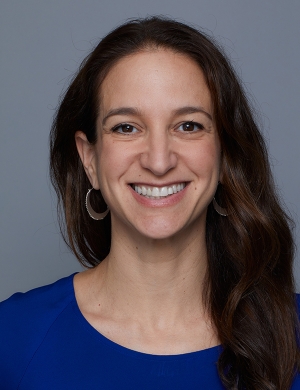 Evidence First host Leigh Parise plays a lead role in MDRC’s education-focused program-development efforts and conducts mixed-methods education research. More