
The Long-Term Benefits of Focusing on Children’s Early Math Skills
Children’s early math skills are a strong predictor of later outcomes, like high school and college graduation rates, underscoring the long-term benefits of focusing on early math education.
States across the country have increasingly focused on early literacy, enacting laws that require screening for reading difficulties, and aligning classroom instruction with the science of reading. This momentum is now expanding to math education, although more gradually.
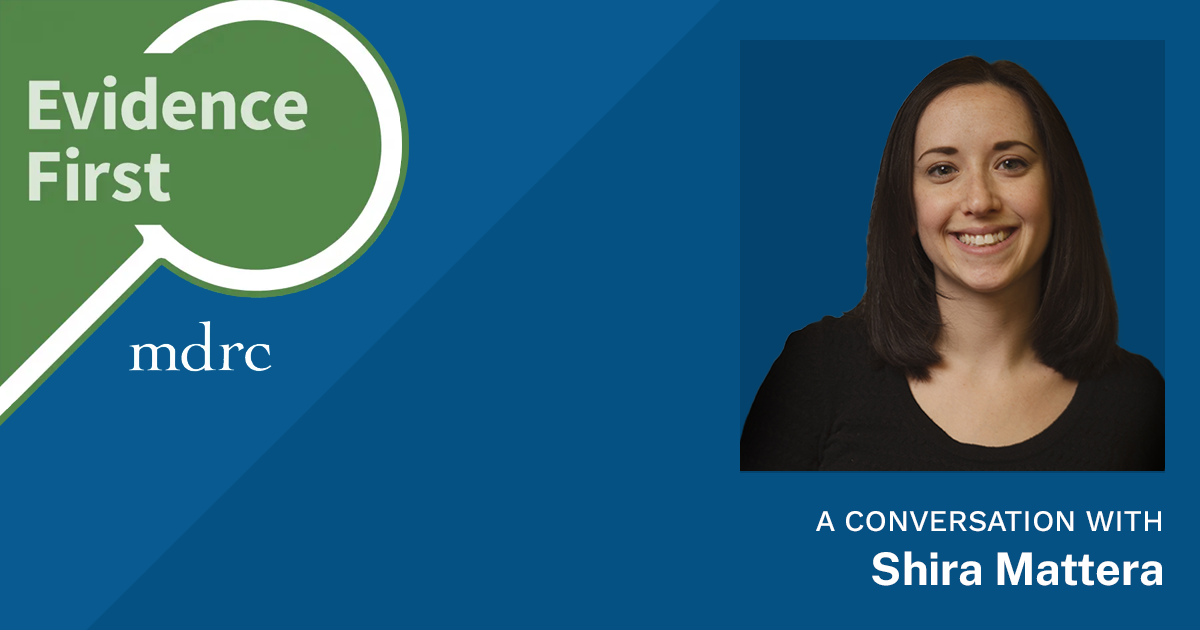
In this episode, Leigh Parise talks with Shira Mattera, a senior research associate at MDRC, who is leading multiple studies looking at early math instruction and skills. They discuss evidence-based strategies that state education leaders can implement to strengthen early mathematics instruction and learning.


View Transcript
Leigh Parise: Policymakers talk about solutions, but which ones really work? Welcome to Evidence First, a podcast from MDRC that explores the best evidence available on what works to improve the lives of people with low incomes. I'm your host, Leigh Parise.
Children's early math competencies are an important predictor of later math and reading outcomes. Early math skills also predict high school and college graduation rates, underscoring the long-term benefits of focusing on early math education. States across the country have increasingly focused on early literacy, enacting laws that require screening for reading difficulties, and aligning classroom instruction with the science of reading. This momentum is now expanding to mathematics education, though more gradually. Today, I'm joined by Shira Mattera, a senior research associate at MDRC, leading multiple studies looking at early math instruction and skills, to discuss what the team has learned so far.
Shira, welcome to Evidence First. I'm really excited to have this conversation with you.
Shira Mattera: Hi, Leigh. Thanks for having me.
Leigh Parise: Let's just jump right in. Shira, I know that your team has been involved in two studies related to early math: Making Pre-K Count and the High 5s project that builds on that. First, can you just tell us more about what early math is? What are we actually talking about, and why is it so important?
Shira Mattera: Sure. I love to start talking about math by talking a little bit about what early math looks like, because I think when people envision early math, they think about kids sitting at desks doing worksheets, and that is not what we're talking about. We're talking about playful hands-on games and fun that children are playing with their teachers, in which they also learn about the conceptual underpinnings of math. This sort of mentally appropriate, early math instructional practices can look a wide range of ways, but they often involve kids moving their bodies and having fun.
I'll give you a couple of examples. A teacher might take a child on a shape walk. They walk around the classroom and they look around and see a clock is a circle, or they might look at the door and say, "That's a rectangle." Another child might say, "And that window is a rectangle too." The teacher can pause and say, "Actually, it's a special kind of a rectangle. What do you notice about that window? Oh, all the different sides are equal. So it's a special kind of a rectangle called a square." In that way the children are noticing shapes in the world around them, learning and having fun, moving their bodies, but also beginning to understand the attributes of a shape, for example.
These kinds of play-based ways of teaching math to children are really appropriate for a child who's three, four, five, and also set them up for success later on. One thing I wanted to note is that all of these examples of play-based math that we'll talk about throughout today really focus on not just the math itself, but also a whole set of other domains. I mentioned the children moving; there's also a lot of language. Oftentimes teachers might ask children to explain their thinking or expand on their knowledge, provide them with vocabulary, and also help them think about things in multiple ways, which is a set of skills that we call executive functioning or self-regulation that allow children to think flexibly and hold lots of pieces of information in their mind. All of those are a reason why early math is seen as what's called a linchpin skill that has effects not just on later math and later math outcomes, but across a wide range of domains for children.
Leigh Parise: Thank you. I feel like—maybe this is obvious— this is a really important place to start. I think a couple of things that you mentioned that are really important to highlight are the play-based components of it. I was a first-grade teacher, and I could tell the students who had been in earlier school, or preschool settings, where they had some experience with these kinds of things, because they asked those kinds of questions that kids who learn from an early age to be thinking and making connections about math to what's happening in their everyday world, really set them up for greater success as first-graders.
The other thing that I think is interesting—I don't, admittedly, always think about this when we're recording these podcasts—but some of what you said I think is also helpful for parents who are looking at early care settings and trying to get their head around, "What are the things that I should be looking for? What should kids be doing or not doing?" Your point about how kids who are learning math are not, as four-year-olds, sitting at their desk and figuring out, “How am I going to do one plus one or two plus two,” but it's really these play-based opportunities for students to begin to learn and engage with these early math concepts.
Can you tell us more about the projects specifically that we mentioned and then what you've learned from that work so far?
Shira Mattera: Making Pre-K Count and High 5s were a joint set of projects that were launched by us at MDRC with the Robin Hood Foundation. In 2010 they came to us and said, "Can we think broadly about what are the types of interventions or supports that young children need in early childhood that can make a difference in the long term?" Gathering information from a whole set of stakeholders, other researchers, practitioners, policymakers, we landed on math because of this linchpin-skill piece that I was talking about, which is that there's evidence that shows that early math is predictive of children's success into elementary school, middle school, and even into high school and adulthood. So we thought this was a good place to start investigating.
Also at that time—and still to some extent—there was not a lot of math going on in preschools, although now that's growing. So it's a great place to support teachers in how they give experiences to children, because there's room to grow there. Based on that, Making Pre-K Count was the first study that we designed. It looks at the short- and long-term effects of children's exposure to an evidence-based, preschool math curriculum called Building Blocks designed by Julie Sarama and Doug Clements, plus a robust set of teacher professional development, ongoing training, and in-depth in-classroom coaching.
What's interesting about the Building Blocks curriculum, which we can talk about some more later, is that it builds on this idea of a learning trajectory, which is really critical for the rest of the math we're going to talk about. It looks at a math goal for a child to achieve. It builds on a developmental trajectory of math that we know exists. There's a way children and kids learn math as they grow, and what they know early on is something that they need in order to build on to do well later.
What a child knows and learns at age four—like these attributes of a shape that I talked about—are critical to what they need to know in order to learn geometry and excel in geometry later on. These two pieces: the teacher having a math goal for the child and understanding this developmental trajectory so they can understand where the child is and what they will need to know next. Then the last piece is having these instructional activities and high-quality instructional materials to support them in finding the right activity to do with a child to build them up to the next level. That is what makes this early math curriculum very powerful.
The next part of this set of studies is the High 5s program, which we developed in coordination with Robin Jacob at the University of Michigan, as well as Doug Clements and Julie Sarama. They developed a program that would build on the Building Blocks preschool curriculum in kindergarten. Children would get small-group, fun, developmentally appropriate math games, working in a group of about three to four children and one trained facilitator, three times a week for about 30 minutes, to learn and extend their math experiences. Those two studies were both conducted as randomized controlled trials implemented in the preschool year and the kindergarten year, respectively.
In the preschool year, whole preschools, whole centers or schools were randomly assigned to either implement the Building Blocks curriculum plus the professional development, or to regular preschool as usual, whatever they had been doing in math beforehand. Then, as the children moved into kindergarten, those who were in the schools that had implemented Building Blocks were then randomly assigned again to either their regular kindergarten experiences or to get this additional High 5s experience. We ended up with children who had had two years of enriched math, and children who had received business as usual, preschool and kindergarten, just what they would've received in the absence of the study. We were able to look at the effects on children's outcomes for children in those two groups, and then we followed the children as they grew into third grade.
Leigh Parise: That sounds like a really cool opportunity to see if what they got in those two years actually stuck, and did it last. I'm curious to hear what you found.
Shira Mattera: What we found was that the children who received both years of enriched math experience had higher math test scores in third grade than children in the control group who received regular preschool and kindergarten as usual. These enriched math experiences early on made a difference for children's math skills, even all the way into third grade, even years later after they experienced them.
The programs also had positive effects on children's English language arts test scores in third grade, and on rates of chronic absenteeism, reducing rates of chronic absenteeism from about 33 percent in the control group to about 24 percent in the program group.
Leigh Parise: Wow, that's really interesting. So this is from getting in preschool and kindergarten, as far as we know, nothing different in first grade or second grade, but we saw effects in third grade in math and ELA, and in chronic absenteeism. Wow. Say a little bit about why you think that might be.
Shira Mattera: We've dug into the chronic absenteeism findings a bunch, and it's a little hard to disentangle. We don't have enough data about what families were doing, which is a big part of why kids go to school or not. But in kindergarten we find an effect on children's attitudes toward math. Children who had experienced these programs had more positive attitudes. We weren't able to survey their teachers, but you could imagine a story in which children are feeling more positive about math, perhaps teachers are seeing them more positively in math, and those children are incentivized to go to school or enjoying school more. Or they're hearing more positive feedback about their experiences in school from the teachers.
Interestingly, these effects also seem to be the largest for the children who came in with the most room to grow. These children, when they started preschool, we assessed them. Some of them had low entering skills in language or self-regulation, and those children had the largest effects later on. So you can also think about how this experience for a child who might be having other challenges in school might be positive or supportive of their self-concept of how they are as a student, as well.
Leigh Parise: Yeah, I think that makes a lot of sense. It's amazing how powerful that can be, and that in this study many years later you're still seeing effects.
I want to zoom back out a little bit. I think it would be really helpful to hear you talk a bit about the current state of math instruction and early math competencies more generally, for kids as young as pre-K. I ask this partly to be thinking about what recommendations you think that we can make for improvement.
Shira Mattera: When we started this study in 2010, there was a lot of evidence building that there was not a lot of math going on in preschool classrooms and in early childhood, and in the early elementary school years. Since then, even as we moved into our study, schools and preschools were expanding to include more mathematics instruction. We know that there's more math going on than there was a decade or two ago, but what that math looks like differs across different districts and across grades. We've done some work looking at alignment of early math experiences for children in preschool, kindergarten, first, and second grade. What we find is that, in particular, kindergarten is not well aligned with what children are experiencing in preschool and then in first grade. We think one of the reasons might be that there's a big shift: Children are moving into a more formal school-based setting often, and we move from two teachers to one teacher, larger groups of children.
This play-based approach and hands-on approach to math really involves being in small groups, moving children around, manipulating the classroom. When you only have one adult and 20 kids, and they might only be three to six months older than they were in preschool, children have to build that independence, and teachers have to help them figure out how to move around the classroom. There's a gap there.
We also find that, in general, in kindergarten, our colleagues, Robin, Jacob, and others, have shown that in schools serving predominantly families with low incomes, children and kindergarten spend something like a third of their time at their desks doing worksheets. There really is this sort of pushdown of mathematical instructional practices from later elementary school into kindergarten. What we are seeing is this need to pull down more developmentally appropriate practice into early childhood and the early elementary school years.
That aligns with many of the practices we've been talking about, about creating opportunities for use of manipulatives, fun play-based approaches, and also an opportunity for teachers to move small group into the math domain. Teachers are really good at doing small group in reading—that's very accepted in elementary school and early childhood—and they're less familiar with it in math. But that small-group piece we think is really critical, because it allows teachers to assess children's skills as they play these games, or interact with them, understand what the child knows, and then start building toward what else could they know. It also allows them to assess children in multiple domains. So we've heard from teachers when we've worked with kindergarten teachers, "Oh, I thought this child was not great at math, but actually their geometry skills are really great, even if their number skills are not." I see this ability in different domains of math, which is a unique and interesting part of math for teachers to investigate.
Leigh Parise: Right. I think one of the things that's interesting is that, as an elementary school, I was quick in the literacy space to think about, "Okay, fluency, and decoding, and phonics," and kind of break down the various types of skills. But for math, I'm not sure that someone taught me to do that, or encouraged me to do that. It sounds like what you're saying is that some of this smaller group also just presents clearer opportunities for teachers to be able to do that in the classroom, which seems great.
Shira Mattera: This is where the professional development that we did really comes in. I think there's a sense in the world that teachers in the younger grades are a little more fearful of math. Some have even said that that's why they're in the early grades, to get away from math. There's a number of components to the professional development that we do. I'd say there are probably four. One is teaching teachers about math and math concepts on its own, so that teachers feel comfortable sharing those concepts with children. Another is expanding the teacher's training about these developmental trajectories that I was talking about, about how children grow, so that they also know not just what the math concept is, but how a child grows and understanding and building toward that concept. Then also supporting their ability to accurately assess children's skill, so that they can find out where the child is through these small groups and other assessments that they use, understand what the child knows and what they need to grow toward. Then the last piece is training on the actual instructional materials, or evidence-based curricular materials, so that the teacher then knows what game to play, and has practiced it, and can play those games with the children appropriately.
All those pieces are important to a teacher going into the classroom and feeling really confident, like you noted, in a math small group, the way that they do in a reading small group.
Leigh Parise: Those four components make so much sense. There's a little part of me that I want to go have a do-over as a first-grade teacher and get more of this kind of support and professional development in the classroom. How common do you think it is that teachers are actually getting that set of supports that you just walked through? I know it sounds like over the last 15 years there's been a huge difference, but I wonder if you've got some sense for the extent to which the supports that teachers are receiving actually looks like what you just talked through, or if that's sort of more the exception.
Shira Mattera: I think the understanding of the importance of math training and knowledge about children's developmental growth in math is growing, but it's still rare, partially because it involves a set of resources that are not always set aside for math instruction. In our study, this involved 11 days of training across two years, so about 5 days of training each year. Then there's a piece I didn't mention, which is in-classroom coaching, which we think is critical, where teachers are really doing the work in the classroom with a coach who's sitting with them, observing, supporting, modeling, and then helping them later on outside of the classroom reflect on their practice, think about how they could have done things, talked about what they've seen, and really are helping them integrate what they're learning in the training into their day-to-day practice. Those two pieces can be resource-intensive and need to be thought about when schools, districts, and states are setting up legislation to support how teachers implement these programs in the classroom.
Leigh Parise: That makes a lot of sense. I mean, it seems like it's both those things and there's a culture and a level of comfort with somebody coming into your classroom and saying, "Hey Shira, you did it like this, and some of the students responded in this way, but here next time you could do it like this." There's also a culture shift sometimes that needs to happen, that I think in some of the schools I've been in is very much the vibe and in other schools less so. So there's probably a lot of components that need to be in place.
You mentioned resources and policies. I want to shift: In your most recent issue focus you talk about how states themselves aren't just focusing on literacy, but actually are expanding the focus to early math skills as well, and starting to pass some new legislation that mirrors reading-intervention models. Maybe now would be a good time for you to say just a little bit more about that movement.
Shira Mattera: Sure. Following on the success of a lot of the science-of-reading legislation and work that states have done, including Mississippi and Alabama, who have been highlighted in this work, many states are now shifting toward looking at math legislation and how they could support schools and encourage schools to do more math instruction in a way that's appropriate, like we've discussed. There are a number of components, but many of these legislative priorities include a focus, as we've discussed, on evidence-based curriculum, teacher professional development, including training and coaching, and assessment. Those three pieces are pieces that we think are really important to include, to support teachers in their ability to implement these programs in the classroom.
For example, we highlight a few places: Florida has passed some legislation that focuses on support for students struggling with early math. Colorado is focused on teacher professional development, and Alabama is focusing on evidence-based mathematics instruction and materials, and this coaching component as well.
Leigh Parise: I would love to see how those things end up being implemented, and then it'll be really exciting to get to track any changes that are happening in those states, or the places who are really focusing efforts and resources on supporting better math instruction.
So Shira, what's next for the field? What do you hope that your team and other researchers are going to be looking at in terms of being able to boost children's early math skills?
Shira Mattera: I think at this point the field has documented through a number of studies—including ours, but others as well—that there's this promise of early math instruction for supporting children's outcomes in the short and long term. There are still some open questions, though. One is understanding the longer-term effects of these programs on children as they enter middle school, high school, and even into adulthood. There's been a movement in the early childhood field to really try to understand these long-term effects as children move into adulthood, and it would be great to see what happens to, for example, kids in our study as they transition into high school and then beyond.
There's also an open question about these aligned experiences. Making Pre-K Count and High 5s were some of the first studies that looked at aligning children's mathematics experiences in early childhood. In an ideal world, there would be a continuum from pre-K to third grade in children's mathematics experiences, regardless of where they are getting their preschool experience. There's plenty of work still to be done about what the best way is to align those math experiences, the teacher's professional development that they get, the curricular experiences that they get, and then these instructional practices that people use.
Finally—and I think our work starts to unpack this a little bit—but really trying to understand where these programs work for whom and under what conditions is going to be critical as states scale up. As these states are rolling out these evidence-based curricula, these mathematics supports, it will be really important to continue to track outcomes for children and understand what's working and what's not. If these programs are working for some groups of students more than others, then how can we help bolster the experiences for children who still need additional support?
Leigh Parise: That's great. Thank you for walking through that. I feel like being able to get a handle at least, or begin to get a handle on some of those questions, feels like it'll be really important, both for informing childcare centers and schools as they're making decisions about how to support their teachers or what different curricula they want to adopt, but also for policymakers, as they're thinking about where to direct local, or state, or federal resources toward this kind of support.
Shira, thanks so much for joining me. It'll be really exciting to see where we head, and it's exciting to have findings that so strongly predict other positive outcomes. I hope that districts and school systems can adopt some of these practices that we talked about to better support their students and teachers.
To learn more, visit mdrc.org. Did you enjoy this episode? Subscribe to the Evidence First Podcast for more.
About Evidence First
Policymakers talk about solutions, but which ones really work? MDRC’s Evidence First podcast features experts—program administrators, policymakers, and researchers—talking about the best evidence available on education and social programs that serve people with low incomes.
About Leigh Parise
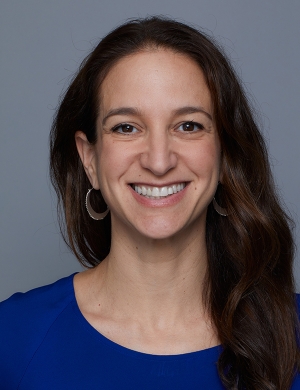 Evidence First host Leigh Parise plays a lead role in MDRC’s education-focused program-development efforts and conducts mixed-methods education research. More