
Partnering with College Systems to Support Students
Graduation rates at community colleges have remained low, especially for students with low incomes.
One effort to help students graduate and succeed in the workforce is MDRC’s Scaling Up College Completion Efforts for Student Success (SUCCESS), a comprehensive student support program supported by 15 years of MDRC’s postsecondary research. Through its Expanding SUCCESS Initiative, MDRC is partnering with states and districts to expand the SUCCESS program to new locations and campuses.
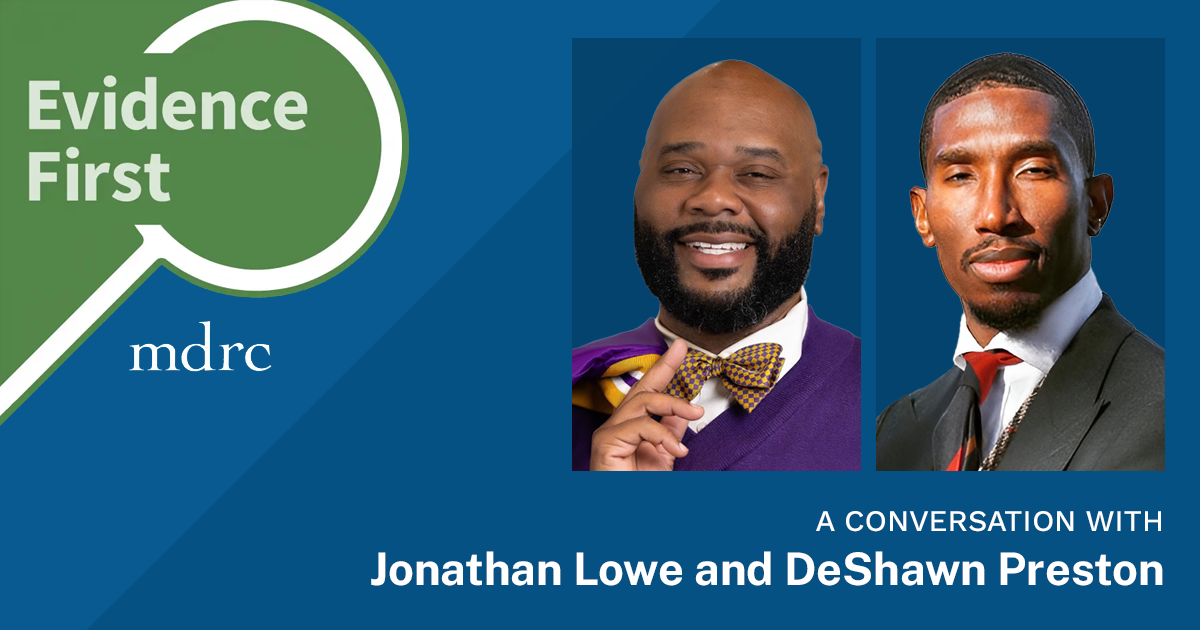
In this episode, Leigh Parise talks with Jonathan Lowe, program director of Coaching for Success at Dallas College, and DeShawn Preston, a research associate at MDRC, about implementing a comprehensive student support model at Dallas College, as part of the Expanding SUCCESS initiative.


View Transcript
Leigh Parise: Policymakers talk about solutions, but which ones really work? Welcome to Evidence First, a podcast from MDRC that explores the best evidence available on what works to improve the lives of people with low incomes. I’m your host, Leigh Parise.
A college degree remains a critical route to economic mobility. But, graduation rates at community colleges have remained low, especially for students with low incomes.
One effort to help students graduate and succeed in the workforce is MDRC’s Scaling Up College Completion Efforts for Student Success (SUCCESS), a comprehensive student support program supported by 15 years of MDRC’s postsecondary research. Through its Expanding SUCCESS Initiative, MDRC is partnering with states and districts to expand the SUCCESS program to new locations and campuses.
Joining me today are DeShawn Preston, a research associate at MDRC, and Jonathan Lowe, program director of Coaching for Success at Dallas College to discuss how Dallas College and MDRC are working together to support the implementation of the SUCCESS model.
DeShawn and Jonathan, welcome to Evidence First! I'm really excited to be having this conversation today.
Jonathan Lowe: Super happy to be here, honored to be a part of the collaboration, looking forward to it.
DeShawn Preston: Yes, happy to be here as well.
Leigh Parise: Great, thank you. DeShawn, maybe you could start with a little bit of background on this model of comprehensive supports called SUCCESS. It'd be great for you just to tell us, know, what do we know about its effectiveness in supporting students through graduation and what are some of the hallmark components of the model?
DeShawn Preston: Sure. So SUCCESS, also known as Scaling Up College Completion Efforts for Student Success, as you can see why we now call it SUCCESS, it is a comprehensive approach for student success model. And it's kind of a CASS [Comprehensive Approaches to Student Success] model that is built on some existing bodies of research. And some of that research includes programs such as CUNY ASAP, Detroit Promise Path, and One [Million] Degrees.
The program is essentially a combination of evidence-based components that provide support to students at an affordable and sustainable level. The important part about this is, or I should say what makes success or these CASS models work, is that there are several components that are brought together, right? Where a student receives all of them at one time in order to support them, in order for them to succeed. And so based on that, there are several components that have come out of the SUCCESS model. As you mentioned Leigh, those being holistic advising, full-time enrollment, regular financial incentives, and using data for continuous improvement. I will say for incentives, oftentimes we have seen something like a $50 monthly incentive for students who remain full-time and who see their coach and or advisor on a monthly or regular basis.
Leigh Parise: Great, all right, thank you. So, DeShawn, we had done SUCCESS as a model, so tell us a little bit about the impetus behind Expanding SUCCESS and what we were trying to do there.
DeShawn Preston: So I think, when it comes to higher education and evidence-based practice, the key is how can you sustain and expand a model to reach as many students as possible, right? And so that's exactly what expanding success is all about. We as a team look to find a district and or state where we can work at more of a top level approach and implement a “train the trainer” model, right? So we can work with the state district or the college system, train someone on the SUCCESS model, and then in return, they go in their states or they go to the colleges within their system to support coaches, deans, directors, right, and helping them to adopt that to reach all students, right? So effectively what you end up with is instead of reaching a couple of thousands of students right now, you're reaching tens of thousands of students, right? And so that's the concept and idea that you want. But also you don't want the concept to die or to live with just one person. So as you adopt that train to trainer model, more people within your state or within your system become more familiarized and more comfortable with the model.
Leigh Parise: Great, thank you. Jonathan, actually, it'd be great if you could just tell us a little bit about Dallas College and then it would be good to hear from your perspective, what the impetus was for implementing Expanding SUCCESS and why you thought it was a good fit.
Jonathan Lowe: Dallas College is located here in Dallas, Texas. All the schools are in Dallas County. We are one college, seven locations. And this is a recent merge from the Dallas County, Dallas Community County District, excuse me, where we were seven different campuses. And so very recently, very recently, within the last, I want to say three years, four years, right before I actually got to Dallas College, all seven campuses merged to form one institution, Dallas College. And now we have seven campuses. And looking at those seven campuses, there was conversation between our leadership and the leadership over at MDRC to help support the campuses that had the lowest retention rate and the lowest matriculation rate of students who would complete math credit courses and english credit courses, what we consider gateway courses, right? These are the two courses that students need in order to enter into those collegiate level courses, right, for their coursework and for their degree plan. And we didn't utilize all seven campuses with the project. We started with just three, our three focus campuses of Cedar Valley, Brookhaven, and the L Central Downtown campus here at Dallas College.
Utilizing the scores of the students, the TSI scores, and the, of course, the retention rate of those students on those particular campuses, made this project paramount to help us get over the hump with some of those students by ensuring that they knew they were fully supported, that there was holistic support available for them in order to do what they needed to do, not to just graduate, but to complete and transfer and go on to whether it was a career or whether it was to another institution. So the train the trainer model was supportive. The SUCCESS model is supportive. Everything that MDRC has implemented or supported us to implement here at Dallas College has been supportive because we were in need to kind of help students get over that hurdle by meeting with their success coach, not just by feeling like they have to figure this monstrosity of college and degree planning and career planning by themselves.
Leigh Parise: Yeah, that makes sense. It's a lot. It's a lot to take on. And I really appreciate how clearly you're framing that this was really able to help you address a problem that you were seeing, and you felt like this had the potential to solve. So I appreciate you starting with that big picture. This was a challenge we were having, and this was a group of students who we really wanted to be able to support. So thank you. All right, so then give us the on-the-ground perspective. What kind of coaching is being provided to the students? Like, you know, how is it different or how does it build on other coaching that might be provided to students at Dallas College? And to the extent that, you know, you've been able to interact with them, what are you actually hearing from students about the impact.
Jonathan Lowe: So, Dallas College is so intentional about the program participation. When this was released to the success coaching team, I was a success coach at the Cedar Valley campus, one of the focus campuses. And I went to an interest meeting. I was not the program director at that time. But I did apply for that position. And leadership felt what better way to ensure the success of this program by getting someone who was already on the ground with students and realizing that students need some form of familiarity, right, in order to build a relationship with a success coach so that we can move towards graduation, right? So I was fortunate enough to be hired as the program director and in doing so, I was able to bring a very fresh perspective to the table when helping to support our students. One of the things that MDRC, Dr. Deshawn and the team were big on was like, this is, here's our model, but we wanna take this model and utilize it to the best of our ability within the Dallas College culture. And so they allowed us to do some things, including the incentive. The incentive is like Dr. Deshawn said, it's a $50 for meeting with your coach twice a month, right? But another thing that we were able to do is the language. Originally we use language like full-time student, where our students work, or our students are not your traditional exiting high school, coming into college. We have students who range from 18 to 55. And so these are working professionals. These are parents. These are community leaders and community organizers. And these are students who are just trying to make it to the next day.
So they allowed us to work the language to support every student because really and truly ground level students need holistic support, not just academic support, not just financial support, not just resource, community resource support, but they need holistic support. And so we were able to work the language to be able to say students who are attending with these many specific credit hours, non-credit hours or at the minimum and those students were able to receive support not just from success coaching, but from the entire Dallas College student success support system. So whether they were special populations and they were military connected students or athletes, or whether they were only able to come to classes, or whether they were taking virtual classes, able to come to classes in the evening, making sure that the student knew that the entire spectrum of resources was available for them.
You know, we would put out flyers and we would send out messaging, but the greatest marketer we found was word of mouth by students. The more students talked about the program, the more students talked about their success coach, the more their value of the program continued to increase because they were hearing it from their peers about how great this program and how great success coaching was.
Leigh Parise: That's really great to hear. I'm so glad that you were able to figure out the right way to fit it in for Dallas College and the right way to make it work for your students. So you mentioned that they might talk to other people about the coaching. What does it feel like? Can you give us a sense for what the students actually experience when they're working with their coaches?
Jonathan Lowe: Sure, you know, and in full honesty, traditionally on our campus, we were working past the narrative that success coaching was just a registration block, right? You gotta meet with a success coach to get registered, but it was so much more than that. And that's what the Expanding SUCCESS model and that's what Coaching for Success offered. We created a curriculum where we didn't just address the student's academic plan.
Dallas College success coaching had already implemented a, what we call, a success plan. So all of the academic qualifiers and academic processes and academic needs for the students were already drafted and written down with the student in a meeting with the success coach. We just took it up a notch higher. We don't want to just talk about your academic progress. What do you look like as a leader? What is your understanding of financial literacy? Do you even understand your financial aid situation?
How are you managing your time? What are your study skills looking like? How do you articulate your thoughts in an email? So we really took a holistic approach to the individual and in doing that our coaches were able to support students at a higher rate. Another thing that we were able to do with our students and engage them, students saw specific coaches. We had three coaches per campus, so nine coaches dedicated to Coaching for Success work.
And they met with students and these students had a trusted voice in their academic journey. So you're talking about a school of 40 plus, 50 plus thousand students across all seven campuses and students have the liberty to take classes on any campus. But if I'm a part of Coaching for Success, I want to be able to talk to someone who can speak to my specific situation where I am as a student. And we were able to dedicate three coaches per campus who can meet with the students tagged in the Coaching for Success program who met the qualifications and they had a trusted voice on their academic journey.
They can go directly to their Coaching for Success coach for any question they had and they didn't just get lost in the mix. So it really brought a high alert to the importance of caseload management. Why do colleges need caseload management? Why do institutions need caseload management to ensure the success of their students? So Coaching for Success for a student was tailored to the student. Coaching for Success for the student was a holistic approach for the student and it wasn't just to guide them towards graduation, it was to guide them in life, help them develop skills and habits that will benefit them not just here, but beyond the four walls of this great institution of Dallas College.
Leigh Parise: Sounds like it would be incredibly helpful for the students and I imagine fulfilling in the kind of coaching that your coaches probably came into the profession wanting to do as well. So that's great. Okay, so one other question you mentioned a number of different populations of students and I understand that you're also exploring how the program could be adapted to support Dallas College students who are not meeting Satisfactory Academic Progress or SAP requirements. So first, maybe you could just share with people what SAP is and then why you think it's important to support this population.
Jonathan Lowe: As the program goes on and we're thinking about sustainability of the program, the MDRC team continue to give us ideas and ways in which this program could sit or be couched in a specific population or in a specific department just to ensure its sustainability. One of the conversations at the table, what are we going to do about our students who are taking classes, who are taking classes, who are not meeting the credit requirements for their financial aid and who are losing money by taking frivolous courses to help them move towards graduation and completion. We realized that we have a subset of students who max out their financial aid at a two-year institution and that's not what we want. We want students to be able to have as much resources as possible as they continue their academic journey.
So satisfactory academic progress simply speaks to students who are taking the right courses, completing the right courses in a timeframe that allows them to complete or graduate with their specific degree plan. And students who are not completing courses, who may take nine hours but only complete three, who have a GPA below a 2.0, students who are utilizing their funds to take foundational courses over and over and over again are not moving towards completion. So how can we help students move towards completion? Would this program fit perfectly with their demographic? Because even though they were aware of the courses they need to take, even though they are aware of their financial aid status and situation, how can we tailor a program around them to actually help them not just be aware, but articulate where they are and help them move towards completion as quickly and as successfully as possible. So SAP is, their SAP population fits with what we do because it's a tailored experience for that person, for that student, right? It helps their student know that they have the support they need not to just take a course but complete the courses that they take.
Leigh Parise: That's great. I really appreciate you digging into that particular population of students who sound like they could really benefit from the types of supports that you're offering.
Right, Deshawn, we talked about this a little bit at the start, but I know that MDRC's goal was to partner with a college system like Dallas College in order to scale the SUCCESS model. And so maybe you could go back and talk a little bit more about kind of why, and then think about your overall approach to supporting Dallas College as they were implementing the model. Like what role did MDRC play here?
DeShawn Preston: Sure. So the role MDRC played was mainly as a bed of resources, right, for Dallas College. So the way in which we started it, we sat alongside Dallas College in their leadership to actually develop what the program would look like, but also making sure that they stayed true to the SUCCESS model, right? And so as we walked them through the process, we inform leaders and decision makers, hey, these are the non-negotiables of SUCCESS. However, here are the things that you can change, right, if you will, to better support the student population that Dallas College serves, right? As Jonathan mentioned, Dallas College doesn't just have the traditional student, right, but they have working students, they have adults, they have students with not just jobs, but children, right? And things of that nature. And so sometimes there's certain things where you have to be a bit more flexible. And so what we were able to do, we were that source of information, right? We were MDRC served as that person who says, hey, we recognize that this is your reality. Okay, well, we supported other colleges that have a similar reality and this is how they've addressed it. So here's something to consider, right?
And so we kind of walk with them side by side in the collaborative spirit and helping them to adjust the SUCCESS model to meet their needs. But once again, staying true to the SUCCESS model as we have found the evidence to prove what works right. And so that was the most important piece. And then also, would say MDRC, we encouraged Dallas College to make this their own, right? So we were the cheerleaders, right? That support section that said, hey, we know we brought you the SUCCESS model, but Coaching for Success is Dallas College's, right? So as you go through that process, hey, we want to support you in how you think about these things and make it your own. Because what we have found out, right, that sustainability and scalability tends to come better when not only there's buy-in, but when a college or an entity sees the program as their own and not someone else's, right? Because if they saw it as this is MDRC's when the grant period is over or MDRC is not walking side by side Dallas College as regularly as we were during the past two or three years, then they're still able to kind of operate and move in a sense because it's theirs, right? They know it like the back of their hand. It's now ingrained in a part of the Dallas College culture, and that's the most important thing for us.
Leigh Parise: Yeah, that feels so important. Thanks for focusing on that really specific point. We underestimate often how important that is to make sure that our partner feels like it is their own. Often we, in our studies, as you know, and as many of our colleagues and others listening, I'm sure know, you could do a program, but then when the people providing the supports step away, It might not be continued, it might not be sustainable, it might shift over time.
But from the beginning, really getting to partner with Jonathan and others at Dallas College to make sure that you felt like this was your own program, and we were just providing some supports to back you up and make sure that it was as strong and based in the evidence as it could be. I hope will mean, for you all that it makes it more likely to continue and that you'll be able to figure out, how to fit it into the kinds of supports that you continue to offer to students. So maybe that's actually a good place for us to wrap up. Jonathan, if you have any lessons that you might be willing to share, lessons that you've learned, or things that are informing the way that you might support students going forward, I think that would be great to hear about.
Jonathan Lowe: One thing the MDRC and the team provided us was this conversation on data and how we look at the data. MDRC was really big with making sure we understood that data is a flashlight, not a hammer. I will not forget that slide. I will not forget that conversation with Dr. Deshawn and Ms. Rebekah and it allowed us to realize that we should focus more on being data-informed and not just data-driven, not just trying to reach the outcomes, but how can we support our students in real time? So perfect example, we run reports on our tagged students in the program. How often are they meeting with the coach? That is the biggest thing we want to know. How often are you meeting with your success coach? Because the numbers show the more the higher your rate of your meeting with your success coach the more successful you are to complete your program in good time. And so we run that data every week. And for those students who haven't met with a success coach at a certain time, you're going to get a communication, not just an email, but a text message. And it's not just going to come from the program director, it's going to also come from your coach. And it's also going to come from your peer, right? Reminding you, let's have a conversation. If not about your academic progress, just how are you doing? Where are you?
What other resources do we have to support you? Do we need to get you to this place or that place? Making sure we are engaging with our students on a very consistent basis and also engaging with them in their space, not forcing them to feel the pressure of coming to an office to meet with the coach. But the coach going to sit in the subway area or in the student center or in front of their classroom, right? Being more accessible.
That data tells us that because if you're not coming to the campus, if you're not coming to the office, it's because you got to go to work as soon as class is over with. So I got to come to you, right? I got to know how to visit you and engage with you. And more that data as a flashlight and not a hammer is something that I would encourage every institution to borrow and even utilize in their culture, utilizing data to be more informed and not just data-driven.
Leigh Parise: Great, thank you, I love that. Right, Jonathan and Deshawn is there anything I didn't ask you about that you think that we should try to cover?
Jonathan Lowe: I can say with the SUCCESS model that the incentive is very important. And it is something that it was the foundation of a lot of conversations to get other students seeing that. I get $50 for meeting with my coach, but it really is the institution's responsibility to ensure that if there isn't a monetary incentive, what makes this visit with this success coach different? So incentive-based programming is very, very important.
But then how do you incentivize a student to meet with a coach? There has to be some sort of success rate. There has to be some sort of evidence that the student will see to keep them coming because the, you know, money is money and it's good to draw you in, but something has to hold you. And so we're working on ways to ensure that students feel incentivized even past our engagement in time with MDRC, our collaboration with MDRC.
Leigh Parise: That's great. So to make sure that they are seeing the value in it, in addition to getting the small incentive, but that they come and that the reason they want to keep coming is because they really feel like they're getting something out of it.
Jonathan Lowe: Yeah, we have several success stories from several students who the $50 was gas money for them to get back and forth to campus. Some students utilize their incentive to, you know, help with the household. Right. But other students, particularly on one campus, we had a student who built a relationship with a coach and this coach literally kept coaching them because of Coaching for Success kept coaching them post-graduation into their transfer institution. So much so that this student after they meet with their academic advisor at their four-year school will bring in and has given FERPA rights to their coach at Dallas College because they are that influential. They were that supportive and our coach was able to continue to help guide while also supporting the student to say, you can still trust your new school's process and model, but I'm always here to support. And I believe that student will graduate in May and our coach will be present at their four-year graduation. So that is gonna be exciting.
Leigh Parise: That's a great story. That's a great success story. Love it. All right. Great. Well, DeShawn, Jonathan, thank you so much for joining us for the podcast. It was really great to have you and great to hear about our experiences together. And Jonathan, get to hear about what's happening on the ground at Dallas College and the great work that you all are doing. Thank you for, for joining the podcast.
Jonathan Lowe: I’m honored, thank you so much.
DeShawn Preston: Yes, thank you for having us.
Leigh Parise: To learn more, visit mdrc.org. Did you enjoy this episode? Subscribe to the Evidence First podcast for more.
About Evidence First
Policymakers talk about solutions, but which ones really work? MDRC’s Evidence First podcast features experts—program administrators, policymakers, and researchers—talking about the best evidence available on education and social programs that serve people with low incomes.
About Leigh Parise
 Evidence First host Leigh Parise plays a lead role in MDRC’s education-focused program-development efforts and conducts mixed-methods education research. More