
Supporting the Workforce Development Ecosystem in Memphis
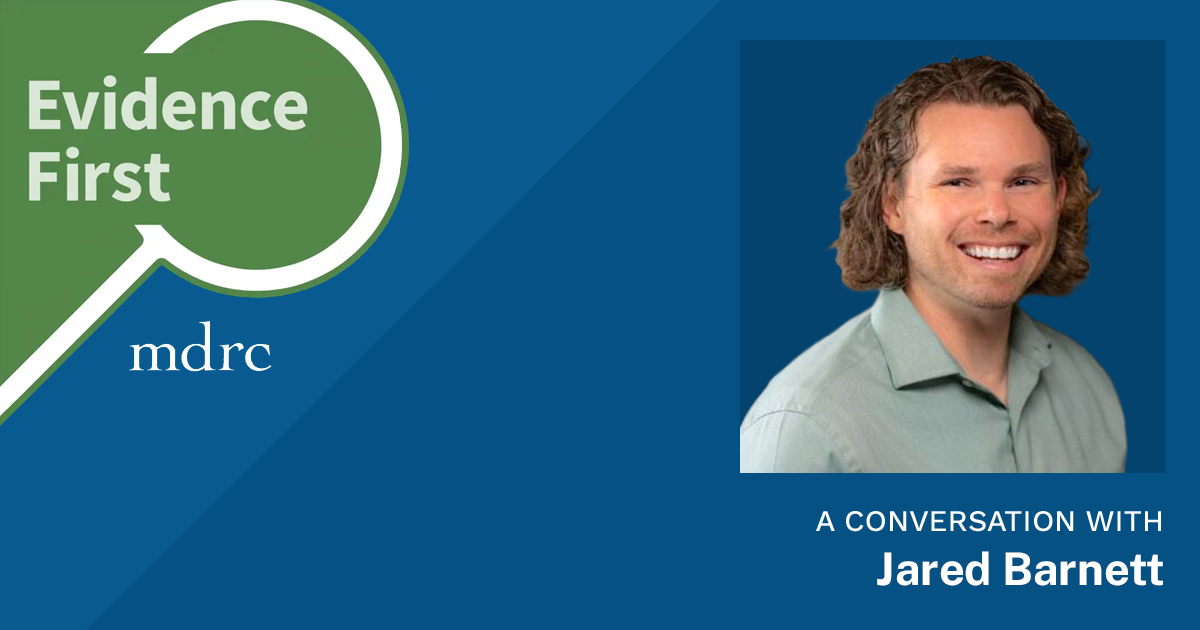
In Memphis, one in three people live near or below the poverty line. Memphis Works for Everyone (MemWorks), a partnership between MDRC and Slingshot Memphis, seeks to strengthen pathways to living-wage jobs for Memphis workers. MemWorks is using research and data to determine what local programs, policies, and interventions will help more workers improve their economic mobility.
In this episode, Leigh Parise speaks with Jared Barnett, president and CEO of Slingshot Memphis, to discuss this partnership and what they’re learning.


View Transcript
Leigh Parise: Policymakers talk about solutions, but which ones really work? Welcome to Evidence First, a podcast from MDRC that explores the best evidence available on what works to improve the lives of people with low incomes. I’m your host, Leigh Parise.
Poverty is a significant problem in Memphis, where one in three people lives near or below the poverty line.
But at the same time, employers face a shortage of skilled workers. What’s behind the disconnect? Memphis Works for Everyone, or MemWorks, aims to find out. A partnership between MDRC and Slingshot Memphis, an antipoverty nonprofit, MemWorks will determine what programs, policies, and interventions may be needed in the workforce development ecosystem to help more workers gain access to living-wage jobs and improve their economic mobility.
Joining me today is Jared Barnett, president and CEO of Slingshot Memphis, to discuss this partnership and what they’re learning.
Jared—really, really excited to have you on today. Do you want to, as we kick off, say a little bit more about yourself or about Slingshot, and then we can dive into MemWorks?
Jared Barnett: For Slingshot, the best way I can put it, we were created to revolutionize poverty-fighting effectiveness through research and analytics. So how can we understand what’s effective at fighting poverty? And then we work with nonprofits to help validate that they’re doing that or help them implement some of those interventions that might allow them to be more effective.
We also work with the funding community to help them understand that if you’re going to give philanthropically, you should expect a return. You should hope to see something change. So how can we help you identify the types of things that will allow that change to happen?
It’s been a neat process to work with all of those parts of the poverty-fighting ecosystem to, again, anchor on what’s actually effective at fighting poverty and how we can support that or make it better in an evidence-based way.
I think Memphis sometimes gets a bad rap and the media loves to point out some of the challenges that might exist here in the city. To me, it’s just this wonderful place of opportunity. We have a great community; people really care about each other. It’s been a really rewarding place for me to be. It was never on my radar as a place that I thought I would live—but the reality was, after my first year here, my wife and I just kind of looked at each other and said, “This is where we want to be.”
Leigh Parise: That’s great. I love that. Thank you. So now Slingshot is focused on working to create more economic opportunities for all Memphians. Can you talk to us about some of the unique challenges that residents in Memphis face, especially related to living-wage employment?
Jared Barnett: I think a little bit of context about the city can be helpful with that. In the rankings, when you look at per capita giving, Memphis is always in the top three there. We’re a very giving city. Philanthropy is a part of the culture, yet our poverty rate was higher in 2018 than it was in the 1970s. And you’re like, Well, why is this not working?
We’ve had generational poverty here that, despite philanthropy, has not changed in a meaningful way. So when it came to workforce development, we were looking at that and saying, “Well, why do we have so many people who would benefit from jobs, yet employers and all the relationships we’ve had talk about that struggle with finding workers?” Nobody could answer why that was happening. People had guesses, but nobody had any evidence to substantiate their hypotheses.
If we’re thinking about why we have not seen improvements, it’s because we don’t know what we’re trying to solve for. And that was what helped us reach some of these specific ideas about Memphis, where I think we’ve got challenges with education. Both K-12 and postsecondary—there are challenges that are holding people back in terms of getting the types of education that they need. There are some structural issues with how our workforce ecosystem functions—or, more accurately, doesn’t function. And then we have a lot of the challenges that come with generational poverty that— You know, when you’ve never seen someone in your family go work in a medical profession, but you typically see the people around you working in jobs that don’t have great runways to economic mobility or progression—it’s harder to see yourself in those roles if you don’t know anybody who’s in them. It’s even harder to get into those roles because nobody you know can help you navigate that. So if the right kind of infrastructure and supports are not in place—it’s really hard to get out of a place if you don’t know how to find anybody who can help you navigate things that nobody you know knows how to navigate.
Leigh Parise: Great; I think that context is so helpful. I will say, I’ve been able to track what you all are doing in partnership with some of my colleagues here at MDRC for several years. It’s been exciting to keep an eye on it and pay attention to what you’re doing, because I think the questions that you’re asking and the problems that you’re trying to solve are things that so many other people are asking and trying to solve. Pointing out some of the things that you just flagged—that we need to help people understand what the opportunities could be and see themselves in those jobs—is really important. [They are things] that we hear come up again and again across lots of different work we’re doing, which I’m sure does not surprise you.
I know you’re partnering with MDRC on MemWorks, and it’d be great to hear about the project’s three stages and why you decided to structure it that way.
Jared Barnett: Those three stages are— We conducted the data analysis and [asked], “What can we learn from the data?” Then we conducted primary research to understand what we can learn from people who are actually trying to navigate these employment pathways. And then the third phase is “What can we do about it?” What kind of action plans can come out of this, either that we can pursue or that we can empower other change agents to try and pursue?
I think the reasoning around that is that starting with the foundation and evidence can alleviate a lot of the biases that we might, as humans, inherently bring into [the process of] trying to understand why these problems are occurring.
Then, what we did was we went out and filled in the cracks in the understanding by talking to the people who are navigating these pathways, the people who are trying to help them at the nonprofits that provide supports, the training providers (in terms of their experience of what it is like training people), and the employers (in terms of what they are experiencing as employers) to round out that data and bring it to life.
It validated some of the things we saw in the data, which is great. That’s what you hope for. But it helped us understand aspects of the data that we wouldn’t have understood otherwise, without having that lived experience. We even identified a few other things that didn’t show up in the data or didn’t pop in the data like other things did, but once we had those conversations and kept hearing the same thing over and over and over again from different stakeholders, we realized, Hey, that’s something there. And we were able to go back and look at the data and realize, Oh yeah, that data does tell a story—which we learned from the lived experience that can substantiate what’s there.
That was the evidence base that we built, which was able to ground all of this work. What was great about it was it was able to bring the whole community together and say, “Hey, as a community, these are the things that we need to be solving.”
That last phase was saying, “Okay, what interventions are effective at addressing the root causes that were identified, and how can we empower people to go do something about that?” One thing we did was build business cases. In business, when you’re trying to solve a problem, you build a business case: What’s the problem you’re solving for? What’s it going to cost to address it? How are you going to address it, and what are the benefits you get by doing so?
We put those together to empower other people in the community to say, “Hey, I can go do something about this.” And we have given them the tools and the understanding about the interventions that are effective at addressing those things that can be solved on their own.
Collectively, between us and MDRC, we said, “What can we do with our skill sets to try and address some of these problems?” We were able to pick two—soon to be three—action plans to say, “Let’s go and do something about this and move the needle now that we know what needs to be solved and how to solve it. Let’s do something about it.”
Leigh Parise: Thank you for walking through all of that; I appreciate how thoughtful you were about it. I have to imagine that the initial data exploration and really listening to the various stakeholders in the community—the people, the training providers, and the employers—must have helped with buy-in. I’m curious to hear more. Can you say a little bit more about how you engaged those people and what some of those interactions (in the community engagement piece) actually looked like?
Jared Barnett: It’s actually really incredible because a lot of those organizations that we engaged with early on are now part of the action plans that we’re doing, because we’ve now been working with them for two (in some cases three) years. So when we went to them—to say, “Do you want to work together on this, or do you want to fund this?”—it wasn’t something that came out of left field; they were part of that.
I think the first thing we did is we went and listened. We identified some employers; we identified some of the training providers and some of the nonprofits and said, “We know from our previous work in the city that you’re struggling in these areas. Help us understand why. What do you see as the challenges? What are you experiencing?”
It’s really easy to get people to talk about the things that aren’t working. You know, when you’re in an environment where there’s no downside—it’s not going to be identifiable—you are able to get some real candid answers. But you get it from their viewpoint, and I think what’s hard is that you see that from your viewpoint as the employer, or from your viewpoint as the training provider. What we had the opportunity to do was then see that across those different stakeholders, and say, “Well, this is how the workforce participant experienced it versus the employer versus the training provider.” We were able to learn from each of them and let them talk.
Then we went back to them and said, “Here’s what we heard across the different stakeholders,” so that they could see it from different perspectives. We were really mindful of not just going and extracting information from them and saying, “Thanks, goodbye,” but coming back to them and sharing: “Here’s what we learned as we did this, from talking with you and others.” That was a process we took throughout it: As we learn from them, take what we learned collectively and come back and share the findings with them.
We did that for What are the employment challenges?—those employment roadblocks. We did that with the interventions: “Hey, what interventions have been helpful for you?” We go hear from others; we do the research, come back, and say, “Here’s what we heard about the interventions.” [We] went through this process of listening and then coming back with insight. The intent was that they would be empowered and get something out of this as well, versus purely being what benefits Slingshot [Memphis] or MDRC: Let’s collectively understand this.
I think because of that approach, when it came time to tackle some of the action plans, they knew what we were talking about. They understood the value of that. They understood the interventions. They were much more comfortable wanting to be a part of it because they had been brought along and were a constant partner collaborating with us, instead of "We went and took everything we could out of that conversation,” and now we’re done talking to them after three years.
Leigh Parise: That makes so much sense. One of the things that I love about the MemWorks work that we are partnering with you on is the actionable piece. It is pushing MDRC as an organization to think even more about that: How do you get information that is useful to people back into their hands so that they can make some decisions about it? Because people have to make decisions all the time. And so it doesn’t need to be that we wait five years until the end of a particular study in order to say, “Okay, here’s what we found and here’s what you might want to do with it.” That you have been so focused on that along the way is great.
Jared, it’d be great for you to talk a little bit about what you and the MDRC team have learned so far, and then share a bit about the solutions that are taking shape.
Jared Barnett: I mentioned some of the academic issues: Right now, we’ve got probably over 110,000 Memphians (is what we estimated) who aren’t able to read or do math at a level that would allow them to continue their postsecondary education or pursue a living-wage job. How do you think about adult academic remediation for basically one-sixth of the city population? That obviously has implications too, then, on childhood literacy, because if you don’t have parents who are literate, it’s much harder to be able to become literate on time through what you can get from a preschool or elementary school. So that was an issue that we learned. And then those who do get to postsecondary [school] don’t finish. One in six Memphians who started a community college program actually graduate, and so we end up with a lot of people who will start pursuing postsecondary but don’t finish it, and therefore don’t get the benefits of what it would have provided.
Those are some of the things on the academic side. I mentioned the workforce ecosystem; we just got some structural things where we have lots of pieces of a workforce ecosystem, but they don’t function as a system. They all work independently and in silos. There’s no coordinating body that helps facilitate all of that. And so you just end up with people trying to do their best, being redundant with each other because they don’t know somebody else is already doing something.
I think what was mind-blowing for us is— We tried to figure out a database of all the different workforce development organizations in the city. We came up with a list of well over 130 organizations, but we were blown away by how hard it was to find some basic things, like, When are you open? Where are you located? What programs do you offer? What do I need to do to be eligible for these programs?
If it was hard for us—where this was our job, and we’re doing it day in and day out— If you don’t have those same types of resources, I don’t know how you can navigate that as an individual, especially from a disadvantaged situation. And that also includes things for Memphis, like transportation, where I think we calculated that 75 percent of jobs in Memphis are not accessible via a three-hour round-trip bus ride. We realized that in our public transit system, we’re a very sprawling city that lacks a lot of density. It creates all sorts of challenges with transportation. You might have a great education and other things, but not be able to get to the job because of the transportation issues.
There are some personal issues too. One of the ones that really stood out to us was the impact of trauma on workforce outcomes. And doing the analysis, there are over 100,000 Memphians who have experienced four or more adverse childhood experiences (or ACEs). The research showed that people who have that level of trauma that aren’t able to process it exhibit the behaviors that we keep hearing employers complain about—dependability, [being] on time, how to manage interpersonal conflict, anger management. All of those things have a connection back to childhood trauma that’s not been treated and managed.
For us, that was exciting in the sense that (1) it’s sobering that it’s impacting that many people, but (2) it’s exciting because that is much more actionable than just saying, “So-and-so is lazy; nothing we can do about that.” It’s now saying, as an employer, “I have someone who’s experienced or observed domestic violence, substance abuse, other types of trauma as a youth—how do we be mindful of helping someone who’s experienced that?” versus “So-and-so is just lazy and doesn’t show up on time.” It reframes something that we observe and hear a lot about. It’s something that’s much more actionable—and quite honestly, allows you to be much more empathetic about what people are actually going through.
Those are some of the key things for us that we’ve learned through this process that, again, took down some of the symptoms that we would see and anchored them on what’s actually causing those things. From there, I think a couple of the ones you mentioned, some of the solutions taking shape—there are two that we’ve actively been working on: one for about nine months, the other one for a little over a year and a half now.
One is a workforce development sector-based strategy in health care. There was an organization that had all of the components that you’d need for an effective workforce or sector-based strategy, but [it wasn’t] resourced to be able to capitalize on that. We were able to help come in and say, “Let’s work together to raise the funds and design the enhancements that could take this from helping people get to jobs like CNA [certified nursing assistant] or these really entry-level jobs that don’t have economic ability, and transition that to the types of jobs that do, like LPN [licensed practical nurse] and medical assistant and sterile processing technician. These jobs don’t require a two-year or four-year degree but can provide the economic mobility that really changes a family’s trajectory.
We’ve been working with them for over a year now. We designed a strategy with them to help say, “What’s this five-year strategy look like? To go from serving less than 100 people a year to, in five years, serving over 300 new people every year?” We identified and designed 10 new job tracks that could be launched. Last year, we launched three of those, and as of the end of the year, we had over 114 people on these pathways to these three different jobs.
We’re excited because we’re at the spot where most of them are starting to wrap up those initial programs and are getting their credentials, and we’re now in the employment phase. For something like LPN, our first two graduates have an average starting salary of over $28 an hour. In Memphis, that’s a game changer, compared with what you often get in an entry-level role.
We learned about the whole concept of a sector-based strategy when we were saying, “What’s effective at addressing some of these roadblocks?” That was one of the singular things that came out as being dramatically effective—taking a sector-based approach versus trying to boil the ocean for the entire workforce ecosystem in one go. Again, we wouldn’t have come to that conclusion without having done the research and understanding what’s really effective. So that was one.
The other one that we launched this academic year is a wraparound support program for low-income–background students in our community college. I mentioned our low graduation rates here. One of the beautiful things, in the research, is that there are wraparound programs that have been incredibly successful at improving persistence and graduation rates—typically close to doubling graduation rates when they’ve been in place and are operating with the right interventions.
We were able to take that research, identify an organization here in the state that already provides that type of wraparound support programming, and partner with them. We worked with them two and a half years ago. We went to them to talk about “What do you do for your wraparound program?” They had published some research about some of the work they’d done in a different part of the state, which we used to help inform some of our work in the data analysis phase. We were able to partner with them and say, “Let’s work with you. We can enhance what you’re doing so it aligns with the research that we’ve identified, and let’s scale it so we can be working with more people.”
That’s been really exciting to be able to see that. A neat thing about that is we said, “We want to double the number of students who are being served in the community college here. But the reality is, we don’t have enough students who are going into the community colleges to reach some of those goals. We just have too much of a drop-off and such a low college-going rate for most of our students here in the city school district that we said, “Let’s also design an access program that can help students access postsecondary.”
So it’s a two-part program: How do we help people once they’re in college—making sure they persist to graduate—but also how do we help more students get postsecondary opportunities so that they can then do that? The way it’s designed is there’ll be this beautiful handoff—working with high school seniors, helping them process everything they need to so that they’re ready to enroll; there’s a summer bridge program that they’ll go to. And then there’ll be a handoff between the access coach they work with in high school and the complete coach whom they’ll work with in college, to manage that support throughout that time frame.
It’s an exciting thing to see. I think, in the first semester, we exceeded all the aspirations we had. It was really neat to see—with things like having the right coach-to-student ratio—what you can do. It’s been neat to see that take off.
On the other piece to that, too: That is funded by the corporations that we approached to get input on what it is like employing people in Memphis. Several of those corporations are now funding that project. We’re six months in and have the first two years and a half of the third year already funded because, again, a lot of these corporations have come along and then some of the corporations that weren’t brought along were introduced to us by the corporations that are supporting it. They reached out to some of their community engagement peers and some of the other corporations in the city and said, “Hey, we’re supporting this, and here’s why we’re doing it. I think your corporation should consider it.”
It’s been really neat to see how that has been able to galvanize businesses (in this case) to support something that will benefit the individuals who go through these programs dramatically. But it also has a benefit for them, because we’ll have a larger pool of skilled workers who will help the employers as well.
I love those mutually beneficial opportunities where it helps everyone, including the community college. Because the more students we help graduate, the more revenue they get from the state, which allows them not just to support the students we’re working with, but all the other students who enrolled there.
Leigh Parise: This is great. I really appreciate the specificity of some of those examples, too. I think there’s a lot for people to learn. Two [things] I’ll note: It sounds like you were very thoughtful about working with organizations that are already embedded in Memphis. So they knew the community, they knew the context, but they needed some support to figure out how to up their game or change what they were doing, based on what we know is actually effective from the evidence base. And then this last piece: thinking about who the stakeholders are who really care about this community and are willing to support it, and are willing to introduce you to their friends and to say to others, “Hey, this isn’t just community giving and support so that you can feel good about it and feel like your company is investing. It’s actually a workforce development strategy for your own company.” That sounds incredibly helpful.
You’ve had a lot of nuggets that will be very valuable for people throughout this. But I want to ask very specifically now, to wrap up: What advice do you have for other localities that are hoping to build the kinds of pathways to employment and economic mobility that you’ve been focused on in MemWorks?
Jared Barnett: One of the first ones is to make sure you know what to solve. Don’t come in guns blazing with interventions if you don’t have a strong understanding of what actually needs to be solved and what the root causes of those [issues] are. I think for us, that process is what allowed us to build the relationships we needed with the different stakeholders. When we finished that analysis and they were a part of it, we could all get behind it. And we didn’t have to go try and convince a bunch of stakeholders that this is this or this is that, but they were part of that process.
Another one is that you can’t do this without lived experience. Business was my background before I got to Slingshot and joined the social sector. So I think a lot in business terms: You wouldn’t design a new product or service without doing consumer research to understand What do you need? and What are your pain points and how can we help overcome them?
We often don’t take that same approach when it comes to social sector interventions. By taking that same approach, there’s just a wealth of what you can learn, particularly within a local market. The things that we learned in Memphis—specific to some of the pain points and challenges—are very different in other communities. And they should be because each community has its own challenges, its own structural issues.
If I had to think of another one here, it’s letting the interventions be driven by the research as well. Just because something worked in a different community doesn’t mean that’s going to work in your community. There are all sorts of different factors. What you can learn is why it worked in that community, and what about that might be relevant for your community. But taking a “cookie cutter” approach is never going to work.
Being thoughtful about what you can learn— That’s probably one of the biggest learnings for me: the beauty of how we were able to blend MDRC’s national understanding of these issues with the local context of Memphis. What can we learn nationally? What do we know locally? And where do we find that intersection?
That was incredibly powerful, I think, for having interventions now that are being implemented that leverage the benefits of both, and being able to bring that to life in a way that is still leveraging research on what’s worked in the communities but is very, very specific to Memphis and the Memphis context. It’s also helped us get more support, because it’s a Memphis-centric solution. It’s not “This worked in New York, so it should work in Memphis,” or “This worked in Dallas—of course it will work here.” No, this is a Memphis solution for a Memphis problem.
Leigh Parise: It sounds like you are a master of helping to figure out how to build buy-in and how to help people understand that you are truly focused on what your community needs. They are very lucky to have you.
Jared Barnett: Grateful to be here and help in the ways that we can. The other thing is that we can’t solve it on our own. I think we’re really clear about that, and that’s probably another learning, right? It takes all the different stakeholders coming to the table in order to make some really meaningful system change. Without that, the research we do just sits in a box somewhere or floats out on the web, because it doesn’t lead to the change that you want to see without bringing the needs of all the different stakeholders to achieve the solutions you want.
Leigh Parise: Thank you so much for joining me. Really appreciate you taking the time and getting to hear about the incredible work you’re doing in Memphis.
Jared Barnett: Thank you so much, Leah. It’s great to be with you. I’m excited to share some of the things that we’re seeing that help make a difference here in Memphis and hope they contribute to the communities here as well.
Leigh Parise: To learn more, visit mdrc.org. Did you enjoy this episode? Subscribe to the Evidence First podcast for more.
About Evidence First
Policymakers talk about solutions, but which ones really work? MDRC’s Evidence First podcast features experts—program administrators, policymakers, and researchers—talking about the best evidence available on education and social programs that serve people with low incomes.
About Leigh Parise
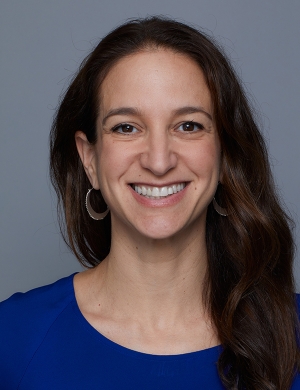 Evidence First host Leigh Parise plays a lead role in MDRC’s education-focused program-development efforts and conducts mixed-methods education research. More