
The Testing Identified Elements for Success in Fatherhood Programs (Fatherhood TIES) Project



Overview
Fatherhood programs are designed to support fathers’ connections with their children, improve fathers’ relationships with their partners or co-parents, and strengthen fathers’ economic wellbeing. These programs usually offer workshops and case management services for dads on a range of topics, including parenting strategies to strengthen child-father relationships, skills to improve co-parenting relationships, strategies for obtaining steady employment, and support in navigating other life or family challenges they might experience. Acknowledging the important roles that fathers play in the wellbeing of their children, families, and communities, the federal government invests tens of millions into fatherhood programs every year. However, studies to date demonstrate wide variability in effectiveness.
The Testing Identified Elements for Success in Fatherhood Programs (Fatherhood TIES) project is an attempt to identify which elements of these programs produce positive effects. Researchers from MDRC, MEF Associates and Abt Global have come together to answer a two-part question: What are the components of fatherhood programs that lead to better outcomes for the fathers who take part in them, and how can we best implement these components in existing programs? In identifying which of these “core components” are most effective and how they are successfully integrated with services, our research team aims to improve outcomes for children, families, and communities as well as individual dads.
Additional Project Details
Agenda, Scope, and Goals
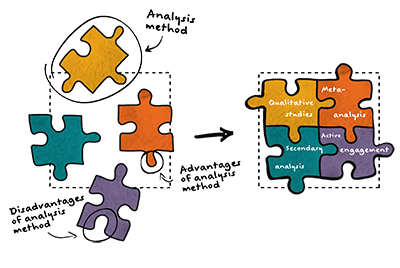 In 2022 and 2023, the Fatherhood TIES team used a multi-method approach to identify core components for rigorous testing. The approach involved four activities: active engagement or conversations with fathers, program staff members, and academic experts; a literature review of qualitative studies on fatherhood programs; a meta-analysis of published quantitative literature; and a secondary analysis using data available across Fatherhood Family-Focused, Interconnected, Resilient, and Essential (FIRE) award recipients.
Based on the results, the core components identified for testing centered on the theme of individual support—both by tailoring services to the needs of the individual and providing those services in one-on-one formats in addition to group-based formats.
The core components of interest included:
- tying program content to fathers’ reasons for seeking services and their specific goals;
- offering tailored engagement support that helps fathers complete program activities and engage in supplementary activities as needed;
- providing specialized staff members who can help fathers navigate complex, bureaucratic systems (for example, family court and child support) that directly affect their ability to spend time with children and have strong and healthy relationships with co-parents; and
- ensuring that fatherhood program staff members can connect fathers directly to forms of support (such as education and employment programs) that they are interested in receiving to help them achieve their goals.
In 2023 and 2024, five Fatherhood FIRE award recipients collaborated with the Fatherhood TIES team to design, implement, and test new services based on the core components identified. The programs prioritized individual supports through three customized approaches.
 Parent Coaching
Montefiore Medical Center’s HERO Dads program (Bronx, NY) implemented one-on-one parent coaching sessions to give dads the chance to practice concrete parenting and relationship skills in a safe space with a trained coach.
 Systems Navigation
Fathers Incorporated (Dunwoody, GA) and Passages Connecting Fathers and Families (Cleveland, OH) implemented systems navigation services to support fathers as they learn about parental rights and work through legal procedural steps, like filing paperwork with family court.
 Financial Supports
Housing Opportunities Commission’s Fatherhood Initiative program (Gaithersburg, MD) and Private Industry Council’s Dads Matter program (Easton, PA) implemented financial support to fathers of $500 per month for three months and financial coaching tailored to the needs of the individual. The sessions support fathers’ financial goals, like finding a job, starting a business, or saving for a home.
Design, Sites, and Data Sources
The aim of the Fatherhood TIES study is to generate evidence on the core components that are most strongly associated with program impacts. In 2024 and 2025. we conducted randomized controlled trials of the individualized supports for fathers in the five fatherhood programs mentioned above and enrolled 1,612 fathers into Fatherhood TIES.
Fatherhood TIES is conducting an impact study and implementation study.
 The impact study is using randomized controlled trials to rigorously evaluate the effects of individualized supports—the core component identified in earlier phases as resulting in positive outcomes for fathers and their families. Specific outcomes of interest include program engagement, father-child relationship quality, co-parenting relationship quality, and issues related to child support, food insecurity, material hardship.
 The implementation study is describing how individualized supports are being integrated with existing services, comparing the supports provided to fathers randomly assigned to test groups to the supports provided to those receiving standard services. Drawing on the experiences and perspectives of fathers and program staff, the study will identify lessons on key elements for successful program implementation and barriers to overcome when implementing individualized services.
The Fatherhood TIES study will collect and analyze many data sources, including surveys, interviews, focus groups, audio journals, photographs, and administrative data sources.
After analyzing and synthesizing findings in 2026 and 2027, the team will share lessons by publishing reports, briefs, and how-to guides that highlight the perspectives of fathers and staff and help policymakers, researchers, and program managers apply these lessons.
Featured Work



Identifying Core Components in Fatherhood Programs Through a Multimethod Analysis Approach