Founded in 1974, MDRC is committed to improving the lives of people with low incomes. We design promising new interventions, evaluate existing programs, and provide technical assistance to build better programs.
MDRC develops evidence about solutions to some of the nation’s most difficult problems. Explore our projects and variety of products, including publications, videos, podcast episodes, and resources for researchers and practitioners.
As part of a research-practice partnership, the NYC Department of Education worked with MDRC to improve its outreach to families and its digital processes for middle school application during the pandemic. This brief describes what adaptations were made, how families reacted, and what lessons the experience offers for the future.
Building Better Evidence on Pre-K Programs by Assessing the Full Range of Children’s Skills
Recent research has highlighted a pattern of “fadeout” of positive academic effects of pre-K as children progress into elementary school. This brief looks at examples of less frequently measured types of skills that pre-K programs may help boost in the short term and sustain over the longer term.
CDI has collaborated with two of MDRC’s long-standing program partners, Per Scholas and the Center for Employment Opportunities, to create and implement tools that can more fully capture participants’ lived expertise. This brief summarizes lessons learned from these partnerships.
MDRC’s Center for Effective Career and Technical Education spoke with Di Xu, associate professor at the School of Education at the University of California, Irvine, to learn from her research on nondegree credentials: short-term training programs that purport to give students skills highly valued in the labor market.
In this commentary originally published by New America, Samuel Maves and Meghan McCormick describe the lessons that state advocates and policymakers learned from implementing pre-K assessment systems. These lessons were discussed during an event cohosted by New America, the Alliance for Early Success, and MDRC.
In this commentary originally published by The 74, Rachel Rosen, co-director of MDRC’s Center for Effective Career and Technical Education, explains how effective CTE models can be adapted to prepare high school students for jobs in new industries that lower carbon emissions.
MDRC’s Scaling Up College Completion Efforts for Student Success (SUCCESS) aims to help more low-income students and students of color graduate by combining proven components into an integrated three-year program. This brief describes the model, the study, and adaptations to the COVID-19 pandemic, and offers some early findings.
Two experimental studies examined multiple measures assessment (MMA), in which colleges use alternative measures (like high school GPA) rather than just standardized test scores, to assign students to developmental or college-level courses. Students placed using MMA were more likely to complete college-level courses. This brief offers recommendations for other colleges.
Recent federal and state policies are creating momentum for combating climate change by tying a clean energy transition to job growth. MDRC and JobsFirstNYC convened 30 stakeholders from locations across the country to discuss how career and technical education and workforce development programs can train people for green careers.
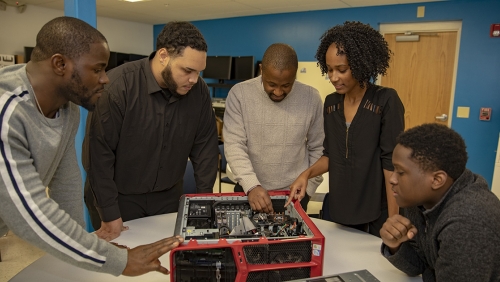
This brief highlights key findings from the implementation of the TechHire and Strengthening Working Families Initiative (SWFI) programs and offers considerations for practitioners involved in planning or implementing similar programs. The programs provided training for high-tech jobs as well as support services to people with barriers to training and employment.
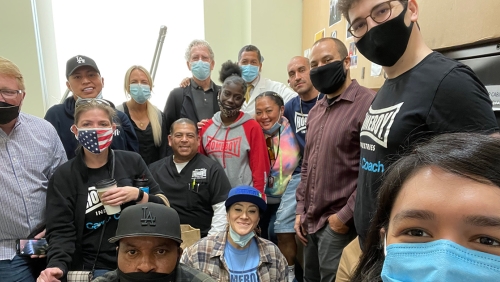
Homeboy Industries (HBI), one of the largest gang rehabilitation and reentry organizations in the world, is transforming its data infrastructure and the way it uses technology to better support its client-centered program services. MDRC recently collaborated with HBI on a project to establish program logic models and to assess the organization’s data collection needs and practices. This post draws on what was learned from that collaboration.
The Impacts of Making Pre-K Count and High 5s on Third-Grade Outcomes
Children who received two years of early math enrichment in New York City had improved math test scores in third grade. The size of the effect is equivalent to closing about 40 percent of the achievement gap between children from families with low incomes and their peers from families with higher incomes.
Three-Semester Findings from an Experimental Study of Multiple Measures Assessment and Placement
Some students are referred into developmental (or remedial) education inappropriately when placed using only standardized placement tests. When multiple measures assessment was used, students in Minnesota and Wisconsin were more likely to enroll and pass college-level math and English courses within three semesters. The additional cost of this alternative assessment averaged $33 per student.
In 2021, MDRC posted nearly 100 reports, briefs, practitioner guides, and other publications—offering evaluation results, profiles of innovative programs, and evidence-backed advice for policymakers and practitioners. Here are 15 of the most popular.
MDRC hosts several blogs, including InPractice: Lessons for and from Practitioners, Ideas and Evidence 2021, the Implementation Research Incubator, and the Future of Career and Technical Education. Here are the top blog posts from 2021.
In this commentary originally published by Higher Ed Dive, Third Way’s Michelle Dimino and MDRC’s Alyssa Ratledge explain how research shows that wraparound support programs are the most effective way to help students earn college degrees.
School-community partnerships are one strategy leaders can use to increase equity in education by building supportive environments that meet students’ social and emotional needs. A recent brief on school-community partnerships included some advice from three leaders of successful district-level partnership programs. This companion brief focuses specifically on these leaders’ suggestions.
To reach policymakers, practitioners, and other important decisionmakers, MDRC experts authored or coauthored more than a dozen commentaries on evidence-based solutions for a variety of venues in 2021. Here are a few of them.
This interactive guide and the accompanying, full toolkit are designed for school-based and community-based programs interested in implementing evidence-based early childhood curricula. The guide provides practical guidelines and tools for four stages of implementation.