Founded in 1974, MDRC is committed to improving the lives of people with low incomes. We design promising new interventions, evaluate existing programs, and provide technical assistance to build better programs.
MDRC develops evidence about solutions to some of the nation’s most difficult problems. Explore our projects and variety of products, including publications, videos, podcast episodes, and resources for researchers and practitioners.
Interim Findings on Developmental Students’ Progress to College Math with the Dana Center Mathematics Pathways
This community college reform directs remedial math students into accelerated course sequences focused on statistics or quantitative reasoning, depending on their programs of study. In a random assignment evaluation, students in the pathways group are enrolling in and passing college-level math at a higher rate than students in traditional courses.
This report from the Community College Research Center and MDRC describes how three institutions — University of North Carolina, Charlotte; California State University, Fresno; and Montgomery County Community College in Pennsylvania — are implementing comprehensive, technology-based advising reforms, including detailed examples of new advising practices, outreach methods, and messages to students.
A key to interpreting study findings is considering not just the features of a program being tested, but how it differs from business as usual — which may change over the course of the evaluation. The Implementation Research Incubator discusses guidelines for measuring this contrast.
The Center for Applied Behavioral Science (CABS) combines MDRC’s decades of experience tackling social policy issues with insights from behavioral science. This graphic explains the CABS’s approach to solving problems.
Benefits and Costs of the RecycleForce Enhanced Transitional Jobs Program
This benefit-cost analysis examines an Indianapolis program that offered subsidized jobs, case management, peer mentorship, and other support to former prisoners. The program reduced incarcerations and increased employment and earnings among participants, and the overall benefits to society from these effects outweighed program costs.
Drawing from the Behavioral Interventions to Advance Self-Sufficiency (BIAS) project, this case study is designed as a teaching guide for students and practitioners. Using the example of an effort to increase participation in a tax-credit program, exercises help readers apply behavioral science principles to a real-life problem.
The Experience of a New Program for Young People Involved in the Juvenile Justice System
STRIVE International engaged MDRC to help the organization improve a new program model aimed at increasing educational attainment and employment of young adults involved in the juvenile justice system. This Issue Focus describes the partnership and offers advice to organizations implementing new programs on how to build evidence of effectiveness.
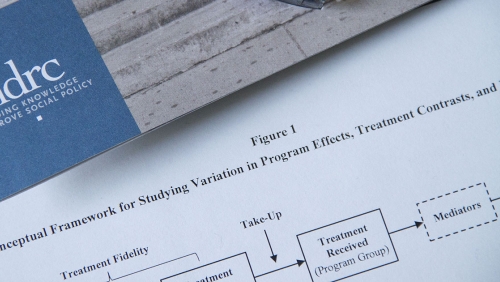
In a randomized controlled trial, measuring treatment contrast – the difference in services received by a program group and those in a counterfactual condition – is critical for understanding what a program’s effects suggest about the best ways to improve services. This paper explains why treatment contrast is important and offers guidance about how to measure it.
Four-Year Results from the National YouthBuild Evaluation
YouthBuild serves more than 10,000 young people each year at 250+ organizations nationwide. In a random assignment study, the effects observed after four years on education and work indicate that the program provides a good starting point for redirecting otherwise disconnected young people, but one that could also be improved upon.
A student success program for Detroit Promise scholarship recipients combines coaching, a monthly incentive, summer outreach to keep students engaged, and a management information system used to communicate with students and track their progress. This Issue Focus provides more detail about the program model and shares early implementation lessons.
Challenges and Opportunities in Summer Programs for Rising Kindergarten Students
One focus of the Expanding Children’s Early Learning (ExCEL) Network is the potential value of programs to promote school readiness in the months preceding kindergarten. This brief summarizes lessons learned from a six-week pilot program and consultation with practitioners on three implementation issues — recruitment, attendance, and family involvement.
Many young scholars supported by the Gueron Fund Minority Scholars Program have enriched our organization by participating in fellowships and internships at MDRC over the last 10+ years. And they have gone on to do wonderful things in a variety of places (including coming back to work at MDRC!).
Testimony of Alexander Mayer, Deputy Director, Postsecondary Education, MDRC, Before the New Jersey State Assembly Higher Education Committee
On May 7, Alex Mayer discussed the challenge of developmental education for low-income college students in New Jersey and nationwide, citing recent innovations and growing evidence about what works to overcome barriers to college success. The strongest programs integrate several strategies, combining opportunity and obligation to address multiple student barriers.
By studying the implementation of an initiative to improve college readiness in rural schools, researchers were able to identify obstacles and help program leaders improve the process. The Implementation Research Incubator explains.
A two-stage study design can test a complex set of interventions, individually and in combination. Reflections on Methodology shows how this approach was used for a pair of programs, the first administered in preschools and the second implemented as a kindergarten follow-up for individual students.
Findings from the Changing Attitudes and Motivation in Parolees Pilot Study
A training program for parole officers in Dallas, Denver, and Des Moines sought to address the persistently high recidivism rates among individuals leaving prison. This study’s results show that officers generally already knew many of the curriculum’s concepts, and changes to their practices were limited.
Many Promise programs — which help local students afford to enroll in college — are looking to add new forms of support to help students address their barriers to college success, but worry about the cost of these new components. MDRC’s College Promise Success Initiative’s Cost Calculator prices out various program designs.
Final Impacts of the Next Generation of Subsidized Employment Programs
“Transitional jobs” are temporary, subsidized jobs meant to teach participants basic work skills or help them get started with an employer. The Enhanced Transitional Jobs Demonstration tested seven such programs for people recently released from prison or low-income parents behind on child support. This report presents the final impact results.
Multisite randomized trials allow researchers to study both the average impact of an intervention and how the impact varies across settings, which can help guide decisions in policy, practice, and science. This Reflections on Methodology post distills some key considerations for research design and for reporting and interpreting such variation.
Latinos are enrolling in California colleges in rising numbers, but their outcomes lag behind those of white students. The Latino Academic Transfer and Institutional Degree Opportunities project is examining the approaches taken by Hispanic-Serving Institutions in California to improve the rates at which they transfer to universities and complete college.