Founded in 1974, MDRC is committed to improving the lives of people with low incomes. We design promising new interventions, evaluate existing programs, and provide technical assistance to build better programs.
MDRC develops evidence about solutions to some of the nation’s most difficult problems. Explore our projects and variety of products, including publications, videos, podcast episodes, and resources for researchers and practitioners.
The Mother and Infant Home Visiting Program Evaluation-Strong Start Second Annual Report
Policymakers have increasingly encouraged greater use of administrative data to produce timely, rigorous, and lower-cost evaluations of health and social programs. This report details MIHOPE-Strong Start’s process of acquiring administrative vital records and Medicaid data from 20 states and more than 40 state agencies to measure health, health care use, and cost outcomes.
Early Findings on the Maternal, Infant, and Early Childhood Home Visiting Program — A Report to Congress
This report presents the first findings from MIHOPE, the legislatively mandated national evaluation of the Maternal, Infant, and Early Childhood Home Visiting program. It includes an analysis of the states’ needs assessments, as well as baseline characteristics of families, staff, local programs, and models participating in the study.
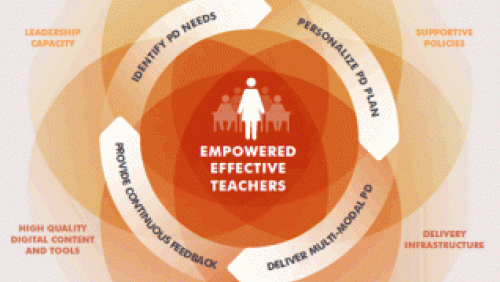
In the Innovative Professional Development (iPD) Challenge, the Bill & Melinda Gates Foundation is helping school districts redesign their teacher professional development systems to better support teachers in increasing student success. This Issue Focus introduces the iPD Challenge and presents some early findings from MDRC’s study of it.
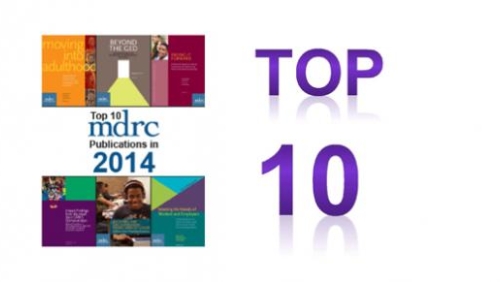
Each year, MDRC releases dozens of publications on programs affecting low-income Americans in all realms of education and social policy. Here’s a list of our top 10 most popular reports and briefs in 2014. (Bonus: see our most-downloaded video and infographic, too.)
Exploratory Findings from the Head Start CARES Demonstration
This report suggests that evidence-based approaches can improve 3-year-olds’ social-emotional competence in mixed-age preschool classrooms. While the findings are promising, further research is needed to confirm the results and to better understand how these benefits are generated.
This paper makes valuable contributions to the literature on multiple-rating regression discontinuity designs (MRRDDs). It makes concrete recommendations for choosing among existing MRRDD estimation methods, for implementing any chosen method using local linear regression, and for providing accurate statistical inferences.
The Youth Transition Demonstration identified and tested service strategies, combined with waivers of certain Social Security Administration program rules to enhance work incentives, to help youth with disabilities maximize their economic self-sufficiency as they transition to adulthood.
Performance-Based Scholarships, Student Services, and Developmental Math at Hillsborough Community College
This program provides an incentive for developmental math students to take their math courses early and consecutively, get help in an on-campus Math Lab, and strive for passing grades or better, in exchange for a modest performance-based scholarship. Compared with standard services, the program's effects are modest but positive.
The Effects of New York City’s Small High Schools of Choice on Postsecondary Enrollment
New data from a rigorous study confirm that New York City’s small public high schools, which have nonselective admissions and serve many disadvantaged students, increase rates of graduation and college attendance for a wide range of groups, including students of color.
The city’s small, academically nonselective high schools have substantially improved graduation rates for disadvantaged students. This report demonstrates that, because more of their students graduate and do so within four years, the schools have lower costs per graduate than the schools their study counterparts attended.
Jobs-Plus — a model proven to help public housing residents find work — is about to be replicated across the country. But to expect similar results as have been achieved in the past, practitioners need to learn from others’ experiences with the program.
Implementation of a Sector-Focused Career Advancement Model for Low-Skilled Adults
The WorkAdvance program model aims to prepare individuals for good jobs in high-demand industries and to increase their prospects for staying employed and moving up. Participants receive career readiness and occupational skills training, job placement, and advancement coaching. This report looks at how four providers translated the model into workable programs.
This project builds on NYC’s earlier experiment with a conditional cash transfer program to reduce poverty and improve education, health, and employment outcomes. It tests a revised model in the Bronx and Memphis, adding family guidance to modified incentives paid more frequently. Early implementation findings suggest deeper family engagement.
Since 2010, MDRC has published a series of reports from its ongoing evaluation of small, nonselective public high schools in New York City. Here are answers to some frequently asked questions about the study.
Using Behavioral Economics to Help Incarcerated Parents Apply for Child Support Order Modifications
A low-cost behavioral intervention increased by 11 percentage points the proportion of incarcerated noncustodial parents in Texas who applied for modifications to reduce the amount of their child support orders. This test is part of the Behavioral Interventions to Advance Self-Sufficiency project, sponsored by the federal Administration for Children and Families.
This report discusses a pilot project to prepare adult education students in New York City for the new more rigorous GED exam. Revised writing and math curricula were offered to thousands of students, but attendance was erratic. Shorter lesson sequences and support outside the classroom might allow more students to benefit.
A 10-year, $50-million initiative, the New Communities Program supported community organizations in 14 Chicago neighborhoods to convene local partners to carry out varied improvement activities, from safety to education and affordable housing. This report describes NCP's successes and challenges and the implications of its experience for federal and local community development programs.
This program aimed to improve health care quality and reduce Medicaid costs for high-needs Medicaid recipients in New York by helping them use appropriate care that would reduce hospital admissions and emergency department visits. The program did not appear to reduce Medicaid costs or care from hospitals and emergency departments.
Three national organizations formed Diplomas Now in an effort to transform urban secondary schools so fewer students drop out. This report introduces Diplomas Now and the associated evaluation, shares first-year implementation fidelity findings, and discusses collaboration among the Diplomas Now partners and between those partners and schools.
In this essay, adapted from remarks made to the Growth Philanthropy Network/Social Impact Exchange 2014 Conference on Scaling Impact, MDRC President Gordon Berlin explains why developing reliable evidence of effectiveness is critical when expanding programs to a large scale.