Founded in 1974, MDRC is committed to improving the lives of people with low incomes. We design promising new interventions, evaluate existing programs, and provide technical assistance to build better programs.
MDRC develops evidence about solutions to some of the nation’s most difficult problems. Explore our projects and variety of products, including publications, videos, podcast episodes, and resources for researchers and practitioners.
Large-Scale Implementation of Programs to Improve Children’s Social-Emotional Competence
This report describes the extent to which three different classroom-based social-emotional strategies and related professional development supports were implemented as intended in Head Start centers, as well as the degree to which teachers’ practices changed as a result.
Founded in 1974, MDRC has had an important impact both on federal and state policy and on program practice in a wide range of domains — from welfare reform and prisoner reentry to youth programs and education reform — in the last 40 years. This issue focus highlights some examples.
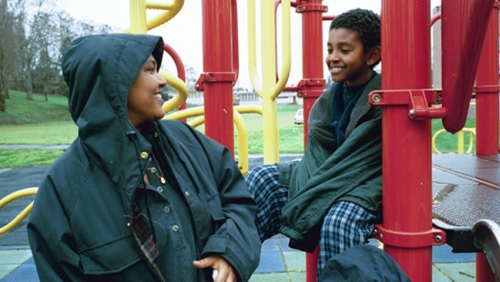
This report, a Public/Private Ventures project distributed by MDRC, summarizes findings from a four-year random assignment study of an out-of-school-time program for middle-schoolers. Students in the program did better on standardized tests and were more likely to attend private high schools.
Early Findings from the Performance-Based Scholarship Demonstration in Arizona
College graduation rates for Latino students, especially Latino male students, are lower than the national average. This report presents findings from a study of performance-based scholarships paired with a robust set of student services designed to help low-income Latino men succeed.
Project Rise seeks to reconnect “disconnected” young people — those out of work and lacking a high school degree — with education, work, and social support. This policy brief provides an overview of Project Rise and its evaluation, descriptions of its participants, and lessons drawn from its early operating experiences.
A Focus on Literacy and Math Achievement Outcomes and Social-Emotional Skills
This report reviews 95 studies on how families’ involvement in children’s learning and development through activities at home and at school affects the literacy, mathematics, and social-emotional skills of children. The review also offers recommendations for additional lines of inquiry and discusses next steps in research and practice.
Early Findings from the Investing in Innovation (i3) Scale-Up
Success for All, a whole-school reading reform, received a federal Investing in Innovation (i3) scale-up grant in 2010 to expand to additional elementary schools. This report examines the program’s implementation and its impact in 2011-2012, the first year of operation, on kindergartners’ early reading.
Too many low-income, college-ready students enroll in colleges for which they are academically overqualified or don’t go to college at all. This brief offers five strategies from MDRC’s College Match Program in Chicago for practitioners interested in helping high school students make the best college match possible.
The Continuing Story of the Opportunity NYC−Family Rewards Demonstration
Family Rewards, a three-year demonstration, provided cash payments to low-income families in New York City for achieving specific health, education, and employment goals. New results show that the program substantially reduced poverty and material hardship while it operated and had positive results in improving some education, health, and work-related outcomes.
Aid Like A Paycheck is based on a simple idea that is gaining national attention: after tuition and fees have been paid to a college, disburse the remaining financial aid to students evenly throughout the term — like a paycheck. This brief describes successful pilot tests at two colleges and discusses policy implications.
This paper examines the properties of two nonexperimental study designs that can be used in educational evaluation: the comparative interrupted time series (CITS) design and the difference-in-difference (DD) design. The paper looks at the internal validity and precision of these two designs, using the example of the federal Reading First program as implemented in a midwestern state.
Increasing Requests for Child Support Order Modifications by Incarcerated Noncustodial Parents
A case study from the Behaviorial Buzz newsletter of the Behavioral Interventions to Advance Self-Sufficiency (BIAS) project focused on increasing requests for child support order modifications by incarcerated noncustodial parents in Texas.
Using Volunteers to Improve the Academic Outcomes of Underserved Students
School-based mentoring programs have been shown to improve students’ academic performance and self-confidence. This study examines what makes the Big Brothers Big Sisters of America school-based mentoring program effective, offering key insights for practitioners. It also contributes a theoretical structure with which to assess other randomized evaluations of such programs.
Interim results suggest that performance-based scholarships improve students’ academic performance and increase the number of credits they earn. In some sites, the scholarships also appear to reduce student debt. In the one location for which data are available so far, the program increased the proportion of students earning a degree.
New Findings About the Effectiveness and Operation of Small Public High Schools of Choice in New York City
New data from a rigorous study confirm that New York City’s small public high schools, which have nonselective admissions and serve many disadvantaged students, have substantially improved rates of graduation with Regents diplomas. This report also describes what principals and teachers at these schools believe accounts for their success.
MDRC is learning what programs work best to prevent at-risk youth from getting in trouble, help juvenile offenders turn their lives around, and give reentering prisoners the chance to get a foothold in the labor market and reduce their chances of rearrest.
Testing a New Approach to Increase Employment Advancement for Low-Skilled Adults
This policy brief discusses a new skills-building model designed to help low-income adults prepare for, enter, and succeed in quality jobs, in high-demand fields with opportunities for career growth. WorkAdvance uses strategies found in sector-based employment programs, combined with career coaching after participants are placed into jobs.
Many students lose their way academically in ninth grade, never recover, and never graduate high school. Ninth Grade Academies aim to ease the transition into high school by creating smaller learning communities for ninth-graders. This report evaluates one urban school district’s effort to implement this complex reform districtwide.
This paper presents a conceptual framework for designing and interpreting research on variation in program effects. The framework categorizes the sources of program effect variation and helps researchers integrate the study of variation in program effectiveness and program implementation.
A Case Study of Two Community College Programs Designed to Accelerate Students Through Developmental Math
“Acceleration” strategies seek to help developmental students progress to college-level math quicker. This report examines two models: one at Broward College compresses a traditional 16-week course into eight weeks and another at Tarrant County College divides a course into modules, allowing students to skip content they’ve already mastered.