
Strategies for Community College Success
A Replication of CUNY ASAP Yields Long-Term Academic and Labor Market Impacts



Community college administrators and instructors are well aware of the challenges their students face in completing their degree programs—and that graduation rates at community colleges are low, especially for students from low-income backgrounds. Over the past decade, MDRC has been involved in evaluating nationwide efforts to increase graduation rates through comprehensive student support programs. One notable endeavor is the City University of New York’s (CUNY’s) Accelerated Study in Associate Programs (ASAP) model, which has been found to double graduation rates. ASAP is a comprehensive program that provides students with up to three years of financial, academic, and personal support services that address multiple barriers to student success. Following the success of the initial program in New York City, CUNY has led a nationwide effort to replicate the ASAP model at 39 colleges in seven states, achieving similarly impressive results. Such remarkable impacts for college support programs are rare, and the consistent success of these programs—in various contexts and time periods—is exceedingly unique.
One particularly interesting replication of the ASAP program is taking place in Ohio. Back in 2015, three community colleges in Ohio implemented new programs based on the ASAP model—with some minor adaptations to address the local context. More information about the program components can be found in the box.
Summary of Ohio Program Model Components
Academic and Financial Support for Students
- Enhanced advising
- Enhanced career development services
- Enhanced tutoring
- Tuition waiver
- Assistance covering textbook costs
- Monthly financial incentive
Student Requirements
- Enroll in classes full time; summer enrollment is encouraged
- Take developmental courses immediately
- Graduate within three years
- Enroll in a consolidated schedule or blocked courses (or both)
- Enroll in a first-year seminar
MDRC is evaluating the effectiveness of the Ohio programs using random assignment, a lottery-like process that places students into either a program group, which has access to the programs’ services, or a control group, which does not (although control group students do have access to their colleges’ usual services). A random assignment design ensures that any differences in outcomes (like increased earnings) between the two groups reflect the program’s direct effect.
This blog post describes the broad impact findings from that evaluation, which shows that the effects of the ASAP model can extend beyond graduation and into the labor market.
ASAP Students Graduate at Higher Rates and Earn More Money
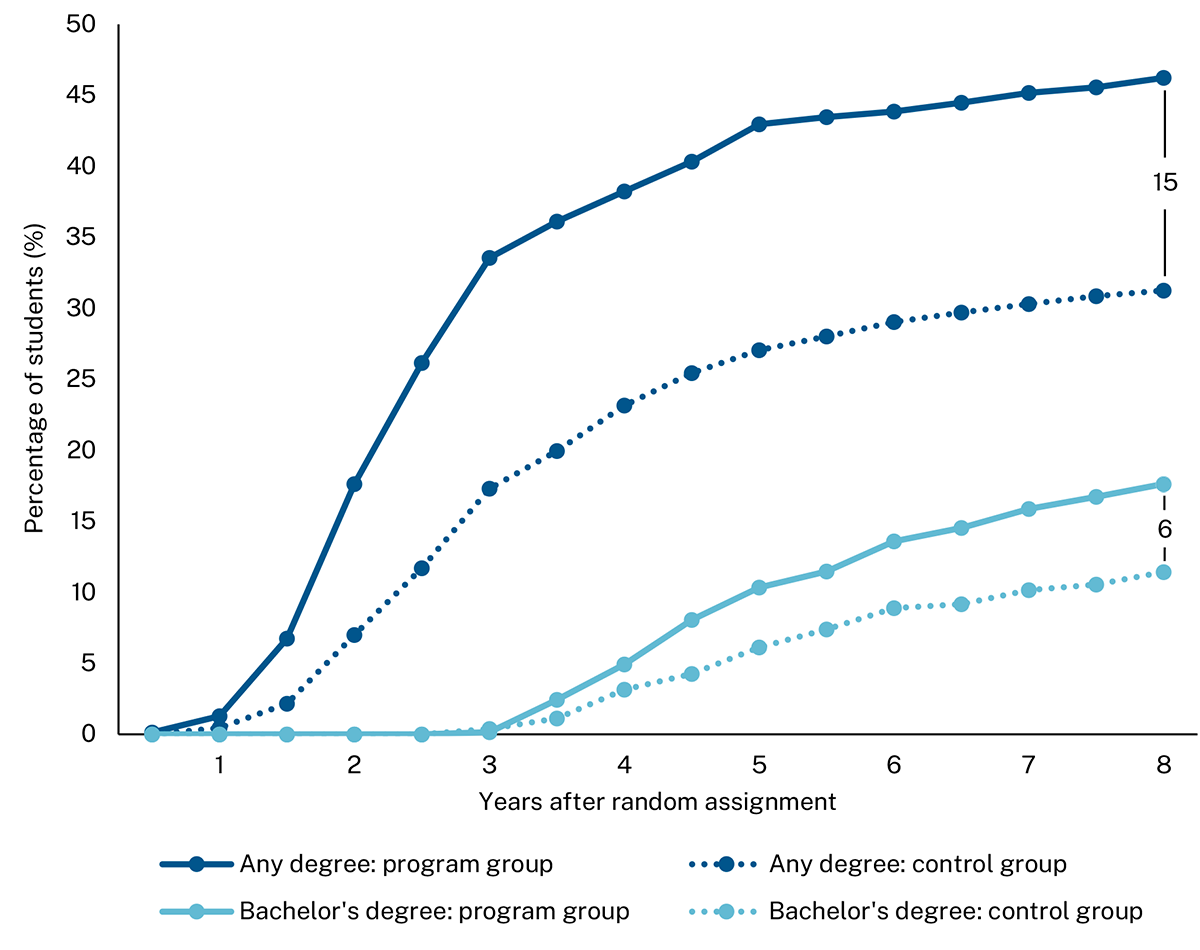
The ASAP model is well-known nationally for its dramatic effects on graduation rates, and the Ohio programs are no exception. The figure below shows that after eight years, 46 percent of program group students had earned a degree compared with 31 percent of the control group—an increase of 15 percentage points, which is among the largest seen in a rigorous evaluation. Furthermore, the programs show effects even beyond community college: 18 percent of students in the program group earned a bachelor’s degree within eight years compared with 11 percent of students in the control group.
The Ohio programs increased graduation rates by 15 percentage points.
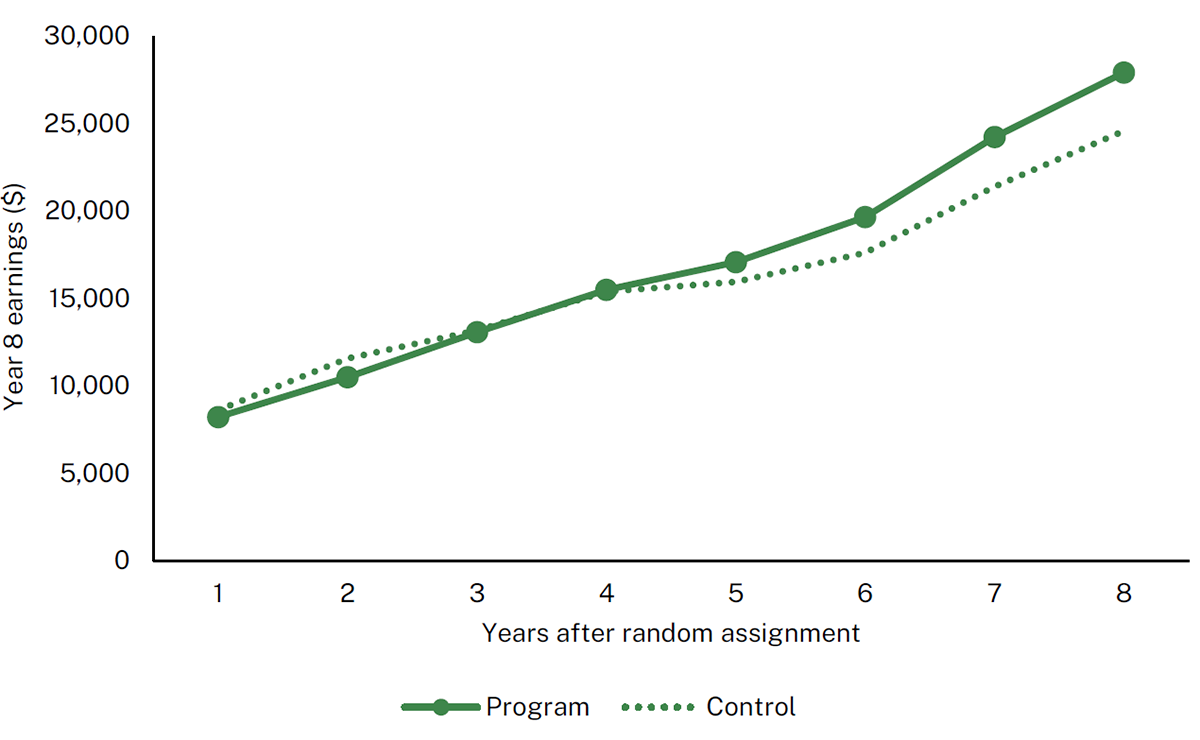
As the labor market increasingly demands workers with postsecondary credentials, improving graduation rates means improving students’ ability to secure family-sustaining wages, and the ASAP model has demonstrated encouraging results for this outcome as well. Eight years after random assignment, students in the program group were earning $3,337 more than the control group’s annual average of $24,596, an increase of 14 percent.[1] These labor market findings are an important contribution to the growing body of evidence that comprehensive approaches can improve both educational and economic outcomes.
The Ohio programs increased annual earnings by $3,337.
In addition to these promising findings, the programs have had large positive effects on enrollment and school progress since the start of the study. Program group students participated in advising, tutoring, and career services at higher rates than their control group counterparts, owing to the proactive and comprehensive nature of support the ASAP model provides. More information about the ASAP program model and the lessons learned from its implementation can be found in a 2020 report that details the program effects after three years. For more information on the evaluation’s eight-year findings, please refer to the 2025 research brief.
Long-Term Follow-Up of the ASAP Model
Taken together, these findings are important because they strengthen existing evidence that the ASAP model improves graduation rates and provide new evidence that the ASAP model can increase long-term earnings. As ASAP continues to be replicated throughout the country, further study of the long-term effects of these programs in a wider variety of contexts is crucial to broaden knowledge on how to most effectively support students throughout college and prepare them for the workforce.
MDRC’s evaluation will continue to collect long-term academic and labor market data, and upcoming publications will explore whether the effects of the programs will continue even further. Community college leaders interested in using this evidence-backed model to improve academic and economic outcomes can contact the CUNY ASAP|ACE National Replication Collaborative.
The long-term follow-up analysis of the ASAP Ohio Demonstration is made possible by support from Arnold Ventures and The Joyce Foundation.
[1] It is important to note that while these earnings may seem low, over one-quarter of the students in the sample had no earnings in Year 8 and therefore lowered the average. In addition, part-time workers are included in the sample, and the data exclude certain categories of employment, notably employment of student workers.