
Economic Mobility Lab Case Study: Brooklyn Workforce Innovations


From 2024 to 2025, Brooklyn Workforce Innovations, a workforce development organization, partnered with the Economic Mobility Lab to develop ways to improve its retention of program applicants. This case study describes this partnership and its outcomes.
About the Economic Mobility Lab. The Economic Mobility Lab (EML) is a technical assistance initiative launched by MDRC to support sector-focused workforce training providers in improving training experiences and outcomes for participants. The initiative’s approach combines MDRC’s workforce expertise and evidence-based practices with human-centered design strategies. In an EML project, staff members from MDRC and the provider form a project team that works to identify a critical service delivery challenge for the provider, design potential participant-focused solutions, and implement and test those solutions. EML is made possible through the generous support of Ascendium Education Group and The Harry and Jeanette Weinberg Foundation.
About BWI. Brooklyn Workforce Innovations (BWI), a New York City-based workforce development organization, trains and prepares individuals for several careers, including those in the transportation industry. It provides skills training leading to an employer-recognized credential and potential employment as a CDL-B driver (licensed to drive commercial buses and single-unit trucks), a job that offers opportunities for economic mobility.
The process used in the BWI and EML partnership involved four phases, following standard EML protocol: the discovery phase, the design phase, the learning cycle phase, and the sustainability phase. For a general description of what occurs during each phase of an EML project, see The Economic Mobility Lab Process Framework.
Discovery Phase: Explore a Focal Area
For the project’s focal area—that is, the operational challenge BWI wanted to address—BWI identified its low application completion rate. In spite of strong initial interest in CDL-B training and high participation in the first step of the application process—attending an information session—many applicants dropped off after that step.
Confirming the focal area. The project team reviewed program application data and found that a high percentage of people who submitted an interest form did not complete subsequent steps of the process. MDRC staff members interviewed front-line program employees, and interviewed and surveyed participants and other program applicants (including individuals who did not complete the application process). The team also reviewed program participation data and created a customer journey map to learn about participants’ experiences with BWI’s application process.
Discovery findings. Findings confirmed that highly motivated applicants encountered process-related barriers to application completion, which stemmed from gaps in clarity and communication. Information about next steps, which was shared during information sessions, was not always retained by applicants, resulting in misunderstandings about the application sequence and how to proceed. Staff interviews further indicated that some applicants were confused by program terminology and incorrectly believed they had already been accepted into the program. These insights highlighted that BWI could better support applicants by providing clearer, more accessible materials and more proactive guidance.
Design Phase: Design and Plan
Using the information from the discovery phase, MDRC led a design sprint, facilitating a meeting with BWI staff members to generate ideas about how to increase application completion rates. The project team hypothesized that completion rates could be increased by ensuring that applicants are fully informed about all steps of the application process and by supporting individuals throughout that process.
Design activities. The project team designed an intervention that involved the following steps:
- Systematically sending automated follow-up emails and text messages after each step in the application process to remind applicants of the next steps
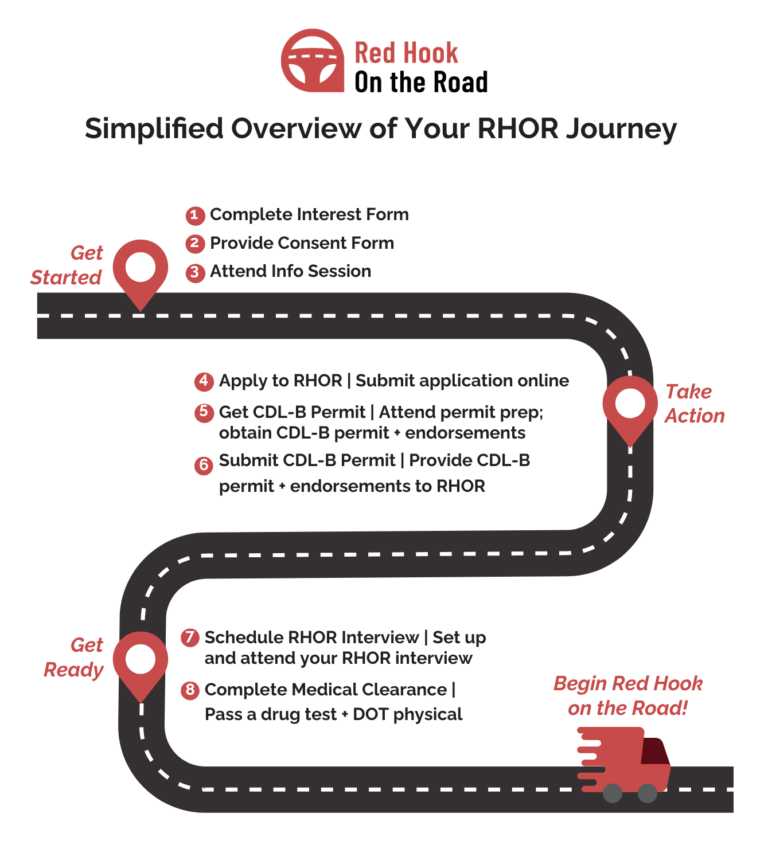
- Creating a visual representation of the application process, shown in Figure 1, to include in the follow-up emails and text messages
- Creating a webpage for applicants with information on the application process
Figure 1. A diagram developed by BWI to help CDL-B training program applicants understand the steps of the application process.
Target outcomes. BWI set the following outcome goals:
- A reduction in employee workloads due to automation of email and text message communications about the application process
- Better informed applicants due to systematic follow-up communications that include links to a new application webpage and a new visual of the process
- An increase in the percentage of applicants who complete an application form after attending an information session
- A decrease in the average time applicants take to complete an application after attending an information session
- An increase in the percentage of applicants who submit their CDL-B Permit documentation after completing an application
- An increase in the number of applicants who enroll in the program
Learning Cycle Phase: Test and Learn
BWI staff tested the intervention starting with applicants who attended the information session in January 2025.
Measurement strategy. The project team used program data and frontline staff members’ input to assess the intervention's effect on employee workloads and participant outcomes.
Results. BWI implemented the intervention, leading to the following outcomes:[1]
- Staff members reported that the new automated communication strategy reduced the amount of time spent sending emails and texts.
- Staff members reported that applicants had a better understanding of the application process and had fewer questions about next steps.
- Attendance at the information sessions increased by 81 percent compared with attendance during the same period in 2024.
- The percentage of information session attendees who completed an application declined by 5 percentage points compared with information session attendees during the same period in 2024.
- Information session attendees who completed an application did so almost three times more quickly compared with session attendees who completed an application during the same period in 2024.
- The percentage of application completers who enrolled decreased by 23 points compared with application completers during the same period in 2024.
The revised process had many positive outcomes. The increase in attendance at information sessions signals that the intervention offered more effective communication to people who completed an initial interest form. Similarly, the decrease in application completion times indicates that the follow-up communications about the application process helped applicants move through the process more quickly, which in turn allowed BWI to fill its training cohorts sooner.
Although there was a decrease in the percentage of application completers and of applicants who enrolled, these changes suggest that better informing potential applicants about the training program and potential job opportunities allows them to make better decisions about whether the training is a good match for them and to discontinue the application process if it is not. This, combined with a 10 percent increase in the submission of interest forms and a 65 percent increase in the number of applications completed compared with the same period for the previous year, suggests that stronger outreach combined with better-informed applicants can result in having a larger pool of application completers.
Sustainability Phase: Sustain and Extend
BWI is sustaining this work in multiple ways.
Refining the existing intervention and adding a new focal area. BWI staff members continue to refine the EML intervention and collect data. They are also implementing additional learning cycles and plan to address a new job placement focal area.
Applying techniques. MDRC began working with BWI to apply EML’s approach to a new initiative focusing on post-training services. The goal of the initiative is to increase the number of graduates who obtain employment in the industry.
[1] BWI was not able to measure the percentage of applicants who submitted their CDL-B permit documentation after completing an application.