
Does An Early Social-Emotional Learning Program Have Lasting Academic Effects Through High School?
High School Follow-Up Findings from a Randomized Trial of INSIGHTS


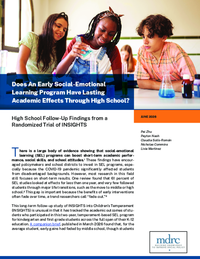

Social-emotional learning (SEL) programs have shown promising short-term results, but much less is known about whether early gains last through high school and the transition to college. This brief presents the final findings from a long-term follow-up study of INSIGHTS into Children’s Temperament (INSIGHTS), a two-year, temperament-based SEL intervention delivered in kindergarten and first grade in New York City public schools. The study follows 1,329 students for 13 years, through their completion of high school and initial college enrollment.
The original, school-level study of INSIGHTS enrolled 22 elementary schools. Building on that study, the current, follow-up study used administrative records from New York City Public Schools and the National Student Clearinghouse to examine whether the program’s early benefits led to differences in reaching major educational milestones later on. A companion brief published in March 2026 found that, for the average student, early gains had faded by middle school, though students from families with low incomes showed modest academic improvements. This brief completes the K-12 picture.
Findings include:
- For the full sample of students, INSIGHTS did not produce detectable impacts on high school outcomes, such as ninth-grade on-track status, attendance, grade retention, special education classification, or receipt of a New York State high school diploma. Overall, students in the INSIGHTS schools and in schools that did not receive INSIGHTS progressed through high school at very similar rates, showing that effects faded over time, as documented in the middle school analysis.
- A separate analysis of enrollment in a postsecondary institution in the year after the students’ expected high school graduation found that INSIGHTS students were less likely to enroll. The research team did not identify a clear explanation for this pattern, which was evident in multiple analyses. Checks of possible explanations, including COVID-19 disruptions, differences in sample composition, and grade retention, did not fully account for this pattern. INSIGHTS students did attend high schools with lower graduation and college enrollment rates and higher concentrations of economic disadvantage, but these differences were small and did not provide a definitive explanation.
- Exploratory subgroup analyses for students from families with low incomes and students whose parents consented to the study did not show sustained benefits through high school. The modest academic advantages previously seen in middle school for students from families with low incomes did not extend to high school.
These findings suggest that a short-term SEL intervention in the early grades, even one that is well designed, well implemented, and initially effective, may not be enough on its own to change students’ long-term educational trajectories. Sustaining early gains may require continued support beyond elementary school. The college enrollment finding warrants further investigation, including into whether differences in students’ later school pathways play a role. This finding should be interpreted cautiously and should not guide decisions about early SEL programs at this stage. More broadly, the study shows the value of long-term follow-up studies: Tracking students beyond the intervention period is essential for understanding how early effects evolve over time.