
Recruiting Clients: Practical Lessons from the BEES Project



Recruiting clients is essential to every social service organization—but many practitioners say it’s one of the toughest parts of the job. Getting people’s attention, helping them see the value of your services, and then supporting them through the enrollment process can take resolve and persistence. This blog post is based on insights from MDRC’s Building Evidence on Employment Strategies (BEES) project, a portfolio of rigorous studies of employment programs.[1] Many BEES programs recruited participants from public benefit programs such as Temporary Assistance for Needy Families (TANF) and Supplemental Nutrition Assistance Program (SNAP) or from substance use or mental health treatment settings. This blog post highlights practical methods that real programs used to reach, engage, and enroll participants—in this case, for services and study participation. All examples shared here are drawn from the BEES experience.
1. Understand your process—and what it feels like to participants.
Strong recruitment begins with understanding who you’re trying to reach and what matters most to them. MDRC worked closely with BEES programs to walk through each step—from first contact to intake—and ask, “Where might someone get stuck, confused, or discouraged?”
Talk to people.
One of the simplest ways to build this understanding is by talking directly with current or former clients. Ask how people first heard about the program, what caught their attention, and whether anything nearly stopped them from enrolling.
In the BEES project, conversations with participants surfaced several lessons:
- Fewer steps meant people felt less overwhelmed and were more likely to enroll.
- Text messages reached people more reliably than phone calls or emails.
- Personal recommendations from former participants carried more weight than flyers.
Map the participant journey.
Trace the participant experience step by step—from hearing about the program to intake and enrollment in the program. Even small challenges, like unclear forms or slow follow-up, can cause drop-off. In BEES, MDRC worked with programs to create process maps that showed where programs might have been unintentionally losing people. With these pain points visible, programs implemented small fixes such as reminder texts, simpler forms, warmer scripts, and more flexible scheduling.
Consider the following:
- Map the steps from outreach to intake to see where drop-off happens.
- Review forms and messages from the eyes of a participant.
- Reduce wait time or add quick check-ins with clients to maintain momentum.
For more information on journey mapping, see Walking in Participants’ Shoes.[2]
2. Get the word out.
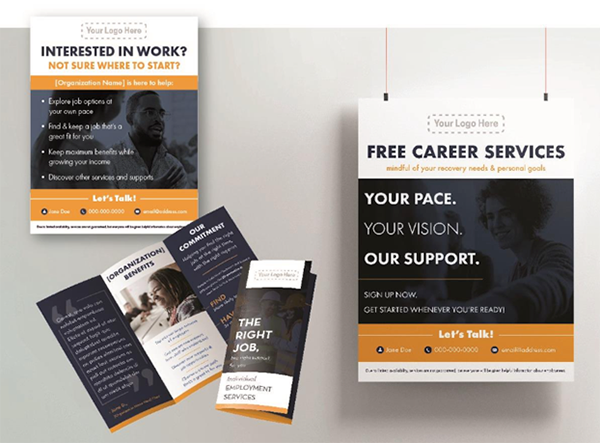
BEES practitioners reported that outreach materials worked best when they spoke directly to participants and highlighted why the program was worth their time. Many social service programs lead with eligibility rules, acronyms, or dense descriptions of services. MDRC worked with BEES programs to shift to plain language, a warm tone, and simple calls to action. The goal wasn’t just to inform people about a service, but to help them see themselves using it and feel confident taking the next step.
Behavioral science corroborates this work: Messages that are relevant, simple, and actionable are more likely to be noticed, remembered, and acted on—especially when they compete with many other demands on someone’s time.[3]
Consider the following:
- Lead with benefits, not bureaucracy—for example, “Get help to start a job you’re excited about.”
- Share short participant stories or quotes to make the opportunity feel real and relatable.
- Make next steps easy by providing QR codes, short links, or online scheduling options.
- Send gentle reminders before appointments to reduce no-shows.
For more information, see Getting Your Message Across with the Effective Communications Checklist.
3. Build partnerships.
BEES practitioners spent a lot of time nurturing relationships with referral partners. Nonprofit housing organizations, health centers, faith communities, or workforce boards are often great sources of new clients. When these relationships work well, they create a steady flow of potential clients who already understand and trust your services.
Strong partnerships don’t happen by accident—they are built through reciprocity, communication, and ongoing stewardship. That means not only receiving referrals but also sending participants to partners when their services are a good fit. When relationships are a collaboration rather than a one-way pipeline, trust can deepen and the broader support network is often stronger.
Consider the following:
- Consistently share updates about specific participants’ progress (with their permission).
- Stay visible through regular in-person drop-ins.
- Create shared moments (like events) that benefit both partners.
4. Keep in touch with former clients.
Former clients can be powerful ambassadors—their first-hand experience can make their recommendations more trustworthy and compelling than any flyer. BEES programs kept alumni visible by inviting them to speak at recruitment events; sharing short success stories with partners; and hosting community gatherings that brought past, current, and potential participants together. These moments built credibility and created a sense of community within the program.
Consider the following:
- Invite former clients to events or orientation sessions.
- Ask alumni to share their experiences in panels, videos, or informal conversations.
- Incorporate alumni stories into partner updates or joint events.
5. Dedicate staff time to recruitment.
Effective recruitment is fundamentally about relationship-building, community presence, and ongoing visibility. It takes time and works well when someone has the bandwidth to do it. In BEES studies, each program had one dedicated staff member who was focused on outreach and recruitment. Recruitment was a full-time, outward-facing role that required being out in the community regularly, strengthening trust, and staying top of mind with partners and potential participants.
Consider the following:
- Dedicate a staff member to outreach and recruitment.
- Hire someone who is strong in relationship-building, marketing, and community work.
- Encourage all staff members to share outreach ideas from their community interactions.
6. Reflect and adjust.
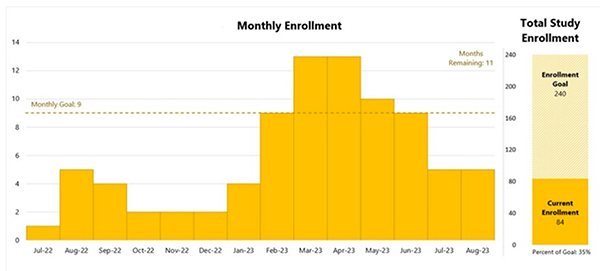
Recruitment isn’t “set it and forget it.” BEES program staff members used simple, real-time data to see what was working and adjust quickly. Visuals showing long-term patterns—like the one below, which MDRC created to show changes like seasonal shifts and the effect of outreach pushes—helped programs spot trends over time. Tracking where referrals came from also helped staff members identify which recruitment strategies were most effective. In one instance, a program’s data revealed that weekly visits to a long-standing partner were generating few referrals; after redirecting outreach efforts to other partners, enrollment increased.
Consider the following:
- Track referral sources and review referral data regularly.
- Review referral and enrollment patterns over time.
- Adapt your approach based on the data.
For more information, see Try, Reflect, Try Again and Filling All the Seats in the Room.[4]
[1] The BEES project is funded by the Administration for Children and Families within the U.S. Department of Health and Human Services. More information is available at https://acf.gov/opre/project/building-evidence-employment-strategies-project-bees.
[2] Rebecca Behrmann, Becca Heilman, Kureem Nugent, and Donna Wharton-Fields, “Walking in Participants’ Shoes: Customer Journey Mapping as a Tool to Identify Barriers to Program Participation” (Office of Planning, Research, and Evaluation, 2022).
[3] MDRC, “Getting Your Message Across with the Effective Communications Checklist” (website: https://www.mdrc.org/work/publications/getting-your-message-across-effective-communications-checklist).
[4] Keri West, Diego Quezada, Jonny Poilpre, and Rebecca Behrmann, “Try, Reflect, Try Again: How Fatherhood Programs Used Learning Cycles in Efforts to Improve Participation Outcomes” OPRE Report 2023-71 (Office of Planning, Research, and Evaluation, 2023); Frieda Molina and Donna Wharton-Fields, “Filling All the Seats in the Room: Using Data to Analyze Enrollment Drop-Off” InPractice (https://www.mdrc.org/sites/default/files/August_2019_post_Final.pdf, 2019).