
An Overview of Dual Enrollment Policies in Three Southern States
Describing the Rural Dual Enrollment Landscape


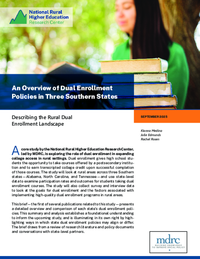

A core study by the National Rural Higher Education Research Center, led by MDRC, is exploring the role of dual enrollment in expanding college access in rural settings. Dual enrollment gives high school students the opportunity to take courses offered by a postsecondary institution and to earn transcripted college credit upon successful completion of those courses. The study will look at rural areas across three Southern states—Alabama, North Carolina, and Tennessee—and use state-level data to examine participation rates and outcomes for students taking dual enrollment courses. The study will also collect survey and interview data to look at the goals for dual enrollment and the factors associated with implementing high-quality dual enrollment programs in rural areas.
This brief—the first of several publications related to this study—presents a detailed overview and comparison of each state’s dual enrollment policies. This summary and analysis establishes a foundational understanding to inform the upcoming study, and is illuminating in its own right by highlighting ways in which state dual enrollment policies may align or differ. The brief draws from a review of research literature and policy documents and conversations with state-level partners.