
The Role of Evidence in Ensuring Student Success: A Conversation with John B. King, Jr.
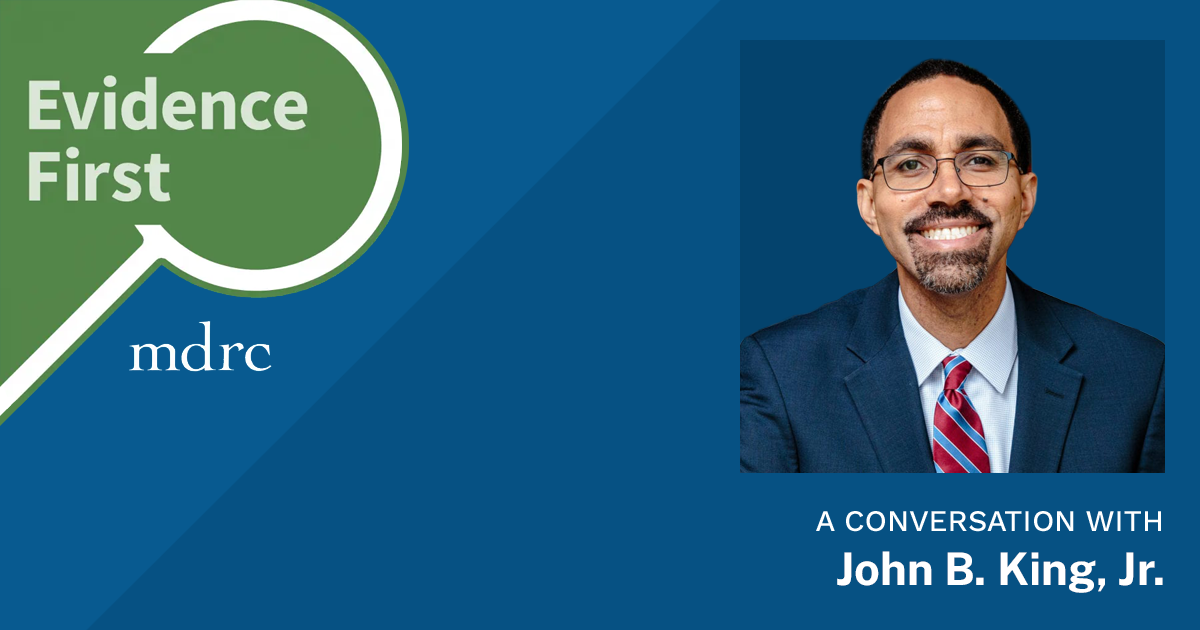
Researchers and practitioners are shaping the future of education and social policy by putting data and research evidence at the center of their decisions.
In this episode, Leigh Parise talks with John B. King, Jr., chancellor of the State University of New York (SUNY), which is the largest comprehensive system of public higher education in the country. King previously served as the secretary of the U.S. Department of Education under President Obama, led the nonprofit organization EdTrust, and was education commissioner for the state of New York. King also serves on MDRC’s Board of Directors.
King and Parise discuss the role of evidence in ensuring student success and the top challenges facing higher education today.


View Transcript
Leigh Parise: Policymakers talk about solutions, but which ones really work? Welcome to Evidence First, a podcast from MDRC that explores the best evidence available on what works to improve the lives of people with low incomes. I’m your host, Leigh Parise.
In each episode, we speak with leaders, researchers, and practitioners who are shaping the future of education and social policy by putting data and evidence at the center of their decisions. Today, we’re thrilled to be talking with John King, Jr., a national leader in education, about the big issues in education right now and the role of evidence.
John has held many roles in government, higher education, K-12 education, and the nonprofit sector. He is currently the chancellor of the State University of New York, or SUNY, which is the largest comprehensive system of higher education in the country. He previously served as the secretary of education under President Obama, led the nonprofit organization EdTrust, and was education commissioner for the state of New York. He started his career as a teacher and as cofounder of Roxbury Preparatory Charter School in Massachusetts.
He is also the author of the bestselling book Teacher by Teacher: The People Who Change Our Lives. We’re also lucky to have John as a member of MDRC’s Board of Directors.
So, John, welcome to Evidence First! We’re so glad you’re here.
John King: Thanks so much, excited to talk with you.
Leigh Parise: Before we jump in, I want to say one quick thing. When it comes up in conversation with people that you’re on MDRC’s board, people consistently comment on how engaging and thoughtful you are on all things education—but then also what a genuinely good human you are. Reading your book gave me a lot of insight into how the educators in your life may have contributed to that. So I really appreciated the book; it was really great. I hope it’s been fun to get to go around and tell people all about it.
John King: Thank you for saying that; I really appreciate that. Yeah, it’s been a pleasure to have done the book. It was a great way to say “Thank you” to the educators who’ve made a difference in my life and also to tell the story of some of my students. It’s been great to be able to share that.
Leigh Parise: Yeah, I love that. Thank you. Honestly, I would like to talk to you about a million things. But why don’t we start in the place that you’re living every day, right now, as chancellor? Because that’s where so many leaders we know are wrestling with this “What actually works?” question in real time. So tell us a little bit about SUNY’s efforts to improve student success and better prepare students for the workforce. Getting to hear things from you—like about what has been particularly effective, how evidence has informed your approach—all of those things will be really interesting for folks.
John King: To give you a little context, the State University of New York has 64 campuses. We have about 390,000 students in degree programs. If you include all the workforce development activities we do, we see upwards of a million and a half students a year. It’s a big, complex system with a range of offerings.
One of my goals, coming in as chancellor three and a half years ago, was to center student success. To me, that means we want to make sure every New Yorker knows there’s a place for them at SUNY. We want to get more folks enrolled, we want to make sure that the students who enroll with us stay with us and complete a meaningful degree or credential, and we want to make sure that our students are successful as they enter the economy. So we think about student success in all those dimensions. Of course, we’re also preparing citizens for the state and country, and we want folks who are prepared to lead good, fulfilling lives.
In order to improve completion [rates], we have a system-wide academic momentum effort. We’re very focused on things like first-year English and math courses and making sure students are successful in those—and shifting courses that might have been remedial to corequisite courses where students are able to make progress. Even as they’re addressing any gaps, they’re still able to earn credits.
We’re doing those things broadly, and then we had one very focused initiative, which you know very well from MDRC: ASAP [Advancing Success in Associate Pathways] and ACE [Advancing Completion Through Engagement]. Those are programs that were first developed at CUNY [the City University of New York] and were focused on providing really intensive advising and wraparound supports for low-income students to help ensure successful completion. MDRC did the original research on ASAP at the community college level that showed that ASAP could double college completion through those wraparound supports—and then showed, with a scaling project in Ohio, that the initial ASAP model could work in other places.
When I started as chancellor, to me it was important to try to scale that initiative, and so we talked with the governor and the legislature about that.
We now have ASAP and ACE at 34 of our campuses, serving more than 7,000 students. The governor has proposed, in her executive budget, funding that will allow us to grow to over 40 campuses with more than 10,000 students next fall.
Leigh Parise: That’s great. I love that you immediately point to two things that stand out when I think about the kinds of things that we found have really strong evidence behind them: reforming developmental education and comprehensive success programs. I love that those are the two things that you point to. I imagine, though, as you came in, that you needed to figure out how to get the support behind those initiatives, right? Talk a little bit about what you needed to do in order to get buy-in or to marshal the resources [that were] necessary. I know that’s one of the things that system leaders are often up against and struggling with.
John King: We’ve been very fortunate in New York that Governor Hochul really believes in the SUNY system and its role in the state. Being from Buffalo, I think she has a particular appreciation for the role that the University at Buffalo—one of our research institutions—plays in the Buffalo region as a driver of economic development. They also have Buffalo State, one of our comprehensive colleges, and Erie Community College. She’s seen how the SUNY ecosystem of institutions can really benefit a region. She’s been a great partner, very enthusiastic about investing in SUNY. We’re fortunate that with 64 campuses spread around the state, 95 percent of New Yorkers live within 30 miles of a SUNY campus. And we have a lot of SUNY alumni in the legislature. For a lot of legislators, SUNY is one of the largest employers in their region.
There’s a real appreciation of the role of SUNY—and for the city legislators, a real appreciation of the role of CUNY. We’re fortunate to be in a state that’s committed to public higher ed. My casemaking has been that if we want students to recognize the return on investment of coming to college, they need to graduate. So that’s been the pitch around our academic momentum initiative—around getting funding for ASAP and ACE.
The other major related initiative is making sure that students are successful when they get into the economy. Partly, that’s about making sure that programs align with regional economic needs. Partly, it’s about giving our students a leg up through our campaign to have an internship for every SUNY undergraduate. We think it’s really important for students to have that initial work experience in their field to help them get a jumpstart on their career.
Leigh Parise: That’s great; thank you. I think that’s really helpful and highlights just how important that narrative and casemaking are. It sounds like that’s something you’ve been really successful at. This podcast is not about me, but I don’t miss any opportunity to shout out Buffalo, where I am from. Both of my parents actually got their teaching degrees at Buffalo State College, which was about five minutes from where I grew up. So I’m a big fan of the SUNY system myself.
I’d love to zoom out a little bit now and build on some of your experiences within New York state. I’m curious, what advice do you have for other system or institutional leaders who are having to make tough choices right now about how to best support students?
John King: Look, I think one of the challenges is—particularly when finances are tight in states—people give short shrift to the very things that are going to help them keep students enrolled, which ultimately is what’s going to drive their financial stability. We’ve been fortunate that the government and legislature have given us significant additional resources over the three and a half years that I’ve been here, but we’ve taken the view that the long-term health of our institutions depends on student success. If students are coming for the first year of college and then leaving, you’re leaving three years of that student’s enrollment on the table. So you want to do everything you can to create that academic momentum that allows students to stay. We know that’s what students come for. Students don’t say “I want to start at this school, do a semester, drop out, and have debt and no degree.” That’s not anyone’s goal. Their goal is to get a degree and be in a position to see the economic benefit.
The thing that I would urge folks to do is be intentional about creating a culture where it is understood that enrollment is everyone’s job—that is, telling folks about why it’s good to come to the school. But it is also making sure that you have the range of supports that will help students succeed. ASAP and ACE are a really great example of intensive wraparound support interventions. But that takes money, and there are other things that you can do that require less investment but also are impactful.
For example, we shouldn’t do this in America, but we do: We make students do the FAFSA every year. We know that in many places around the country, students do the FAFSA as a high school senior, they get financial aid for their first year, and then they don’t do the FAFSA for sophomore year or junior year or senior year. So why leave those financial aid dollars on the table? Make sure everybody does the FAFSA.
Why put students in remedial courses that we know are very unlikely to lead them to stay in school? Those remedial courses take time, they take energy, they cost money, and they don’t get you any closer to a degree. So move to corequisite [courses]. We know that students with a degree plan—Which classes am I going to take each year? How does that fit into my major? How does that serve my career goals? What is my plan?—when they develop those degree maps with an advisor, they’re more likely to be successful. We’re trying both to do these intensive interventions with ASAP and ACE and then, at the same time, to do these larger campus-wide strategies that are going to help everybody get through to the degree. That’s the work that every campus should be engaged in if we want to deliver on the promise of higher education.
Leigh Parise: I really appreciate that. One of the things I’m struck by, as you give that answer, is that you started a lot of those statements with “We know this; we know this.” You’re pointing to all of these things that are about what research has told us works and is worth spending time on. I’d love for you to say a little bit about how you keep up-to-date on that, or how you encourage others to do that or build a culture that’s focused on that.
John King: Well, certainly, being on the board of MDRC is helpful because you and your colleagues generate a lot of very useful information for not only higher ed leaders, but folks in education. That’s very helpful. To be honest, you know, my enthusiasm about ASAP and ACE is part of my pitch.
It really began long before I was SUNY chancellor. I had been following MDRC’s work in this space for a long time, long before I was on the board of MDRC. I was following that work, lifting up that work, when I was the secretary of education for President Obama. So I knew coming in the door that this was work that I wanted us to invest in.
MDRC is a useful resource. I am a diligent reader of all the higher ed periodicals, Inside Higher Ed, and The Chronicle of Higher Education. Part of what I’m reading for is if somebody has a good idea, I want us to take advantage of that. My team knows I read a million things every morning, often while I’m on the treadmill. By the time I start my day, I’ve already sent four or five articles to different people. “Hey, did you see this, which is working at this campus? Are we doing that? Hey, did you see this new report from MDRC, or this new report from New America, or these new findings from a research study from a think tank in another state? Let’s see what we can learn about that. What can we build into our academic momentum strategy or our internship strategy?” We also have a strategy to embed workforce-connected certificates and credentials in other academic majors: Maybe you’re majoring in sociology, but you pick up a credential in data science along the way. So you’re better positioned to get a job, right? Wherever I see evidence of stuff that’s working, we try to take advantage of that.
Leigh Parise: I love hearing that. I’m sure The Chronicle and Inside Higher Ed are really thrilled to hear that you’re a diligent reader. I think it’s on all of us, also, to do a really good job communicating clearly and concisely what it is we are learning. I like to think that that is something that MDRC is getting better and better at. But it is always good to hear that there are consumers out there who need to make decisions and are hungry for that.
One of the things you mentioned is that you were the secretary of education. Let’s zoom out even more. You have a lot of experience in government in different roles. I’d be curious to hear you talk about how you’ve seen research shape public policy decisions. You’ve obviously talked quite a bit about how, as the chancellor of SUNY, you make real decisions about what’s happening across SUNY and what’s happening in practice. I wonder if you can talk a little bit more broadly about how you’ve seen research shape some public policy decisions.
John King: One of the things I’m worried about is that, in this current moment, it seems like we have lost some of the momentum behind evidence-based policy. If you go back to when I was the state education commissioner in New York or when I was the secretary in the Obama administration, there was a lot of conversation about the need to better leverage evidence in the education sector in particular—and an argument that we should try to draw some lessons from health care, where there is a tradition of really rigorous evaluation of interventions and professional responsibility on the part of health care providers to know what the latest evidence is showing. If you’re a cardiologist, you’re expected to be up on the latest information about what we’re learning to improve folks’ heart health and the latest procedures to address heart problems. We were trying, in the Obama administration, to accelerate those efforts in education.
We had the Investing in Innovation grant program—the i3 grant program—which was designed to have people test and then scale innovations. There was a lot of bipartisan enthusiasm for that at the time. Actually, the Every Student Succeeds Act, which was signed into law in 2015, codified the i3 program—[using] slightly different language to describe it, but essentially codified this idea that there would be federal funding streams that would be tied to the development of evidence and the scaling of innovations with proven evidence of success. Certainly, in the Biden administration, there was the creation of the Postsecondary Success Grant Program. That, too, was about scaling proven interventions. IES [Institute of Education Sciences], as part of the Education Department, had “Try to build evidence around what works” as its chief mission. Unfortunately, the bipartisan support around that has frayed, for sure—and, frankly, not just in education, in health care too. I mean, it’s actually shocking, some of the ways in which policy is now disconnected from the evidence. [It’s] scary around vaccines, for example. But I hope we are going to be able to get back as a country to this idea that if we’re going to spend public dollars, we ought to do rigorous evaluation, figure out if those dollars are being leveraged to maximum effect, and adjust our behavior based on the evidence.
Leigh Parise: I obviously could not be more with you. Recently, one of your colleagues, an MDRC board member, came to do a little lunch forum for MDRC. One of the things that she talked about was that even though we are living in a moment where it does feel like people are asking some questions about evidence, and it feels like it’s undermined in some ways, we have to continue to beat that drum because it is a long-term game. So continue to do the day-to-day work of focusing on how we can bring rigorous evidence to answer questions that real policymakers and practitioners are asking. I think for us, one of the things that helps to continue to drive our day-to-day work at MDRC is that when we engage with leaders of systems (like you) or leaders of nonprofits, they’re still saying, “I have to make decisions. I have to invest resources. I gotta know what is most likely to make a difference for the people who I am serving, the people who I care about.” Even in a moment when it feels like there are some real challenges and pushback on evidence, I think that the parallels that you drew to the health field—thinking about how it’s our responsibility to be up on what works and to know the latest thing—are important, and I appreciate that.
One of the things that you talked about was the i3 grants that you worked on, and some of the other federal investments in things like scaling. Let’s stick to scaling for a moment. I think one of the things that we see over and over is that a lot of evidence-based programs might show success in a study or a pilot [test], but then really struggle to scale. I would love to hear you talk about how you’ve managed to scale programs like ASAP and ACE system-wide in SUNY—and the kinds of things that you’re paying attention to, as you do that, to make sure that they’re going to have the kind of impact that you want them to have on students.
John King: Sure, and this is a place where we need more investment, actually. It was one of the ideas behind i3, and certainly part of the mission of IES: to do scaling studies, to say, “We’ve seen this intervention work in Place A, so we’re gonna test it out in Place B or Place C or Place D, and we’re going to evaluate whether it works to scale and what some of the changes are or what the obstacles might be.” I think about the Ohio scaling study for ASAP and how, at the original ASAP program at CUNY, MetroCards were key. Students got the MetroCard. Obviously, that’s a big financial saving, but also, they got the MetroCard when they came to their advisor meeting, so it was a good incentive for students to go to the advisors.
While you’re in a more rural or suburban area of Ohio, a MetroCard is not going to be very useful, but a gas card is. And so, when we started our scale-up of ASAP and ACE, we had the benefit not only of the original MDRC work on the ASAP program at CUNY but also of the subsequent work on the replication in Ohio. So we can learn those lessons. One of our campuses, Westchester Community College, was actually already replicating ASAP (through what they call their Viking ROADS [Realizing Opportunities for Academic Degree Success] program) when I became chancellor. I could already point to “Hey, we’ve got a campus that’s already started on this.”
One of the best things that I was able to do was to recruit Donna Linderman, our senior vice chancellor for student success. She had been one of the architects in building ASAP and ACE. It’s one of the first coffees I scheduled, when I knew I was going to take this job as chancellor at SUNY: I called Donna and I said, “Let’s get coffee.” I sat down with her, and I said—my opening line of the conversation was—"I need a Donna Linderman for SUNY; help me find that person.” That conversation turned into Donna saying, “Actually, it might be fun to join you.” So we ended up, from that conversation, deciding to do this work together. Donna—who so intimately understood not only how ASAP and ACE work, but how they have been scaled across multiple CUNY campuses—was able to bring those insights to SUNY. We were very clear with campuses: “Here’s what fidelity looks like to these core elements. Each campus is a slightly different situation, different program mix, different geography, and different student mix, and so here are the places where you can adapt, add, and enhance. But you have to stick with fidelity to the core model around the advising, the cohort experience, and the data tracking.” And it’s worked incredibly well. We started with a smaller number of campuses, and then people said, “Me too! Me too! I want to join!” So we were able to grow. Now we’ve got this next cohort that’s just waiting for the state budget to be approved so that they can join the program in the fall.
Leigh Parise: I love how you talk about that rollout in a way that makes it feel doable—and makes it feel not crazy to think, Okay, you could actually do this across the whole system. One of the things I wonder about and that I’ve heard you talk about before is—I’ve heard you talk about it in the K-12 context—teachers are asked to do so many things. You can only do so many things, and when you’re asked to do another thing—when last year or last semester you were told “Now we’re gonna pilot this thing; now we’re gonna try this thing”—how do you, as a system leader, get people to say “You know what? Yes, this is a thing that I will prioritize and I will pay attention to” and not have it just be another thing? How do you actually get people to buy in and understand “No, no, this is the one that really is going to make a difference for you and for your students, so therefore it is worth investing your time and energy into making sure you’re doing it with fidelity.”
John King: Great question. I think it starts with a little bit of evangelism. Donna and I were both telling the story of the successful impact that the original ASAP and ACE had and telling the story of the Ohio replication and the impact there. We were trying to build buy-in, too. It was optional. We said to campuses, “Here’s the money. Here’s the program design. Here’s what fidelity looks like. But you gotta choose to do this.”
I mean, it would have felt different if we had imposed it on campuses. There are sometimes initiatives that we impose. We require a Title VI coordinator on every campus because we think it’s important to ensure that students are protected from discrimination or harassment on the basis of race or ethnicity. We do sometimes have to impose system-wide policies. But this was a case where we wanted the buy-in, and so there was that element of choice. The third—and this is really important—is when people see it working, the buy-in grows. You start out with ASAP, and you’ve got your ASAP coordinator on campus and maybe an ASAP counselor. They’re working with the students, and that’s not necessarily visible, let’s say, to every faculty member. But when a student gets a bad midterm grade and they show up for office hours and say “I’m at office hours because my ASAP counselor told me I needed to come to office hours,” then that’s a faculty member who’s bought in and is saying “Wow, that’s great. That made my job easier.”
What we’ve seen on the campuses that are doing ASAP and ACE is that over time, there is greater and greater buy-in as people see it working. Now the question often is, Why can’t we do this for everybody? And of course, you know, there’s a cost to the program. We haven’t gotten that level of resources from the state to be able to do it for everybody. But we are trying to draw some lessons from the success of ASAP and ACE that we can apply to campuses more broadly.
Leigh Parise: Great. I want to ask you to step back a little bit or do a little bit of predicting about what’s most useful for folks. I’m curious, from where you sit, what do you see right now as some of the most urgent issues that are facing leaders in higher education? I ask this partly because I wonder if there are areas where more evidence might be particularly important to have.
John King: Three things I’m really, really worried about: One is this attack on the role of higher education in our society and people saying, “College doesn’t matter” when we actually have really good evidence that it does matter, a lot—that you earn a million dollars more over your lifetime if you have a bachelor’s degree. (I think it’s some $400,000 or more if you have an associate’s degree.) There are very few jobs that provide a family-sustaining wage that are available without some postsecondary education. It might not be a degree, it might even be a career credential, but it’s something more than a high school diploma.
We have a lot of good economic evidence, but it’s not well understood. People have, I think, been discouraged by the proliferation of predatory for-profit colleges that stole people’s money and left them with debt and no meaningful credentials. That’s made people more skeptical. People see the sticker-shock pricing at some of the private institutions, not realizing that at SUNY, our tuition at our four-year institutions is $7,070 for the year. We’re in this moment where there’s declining public confidence in higher ed, and yet so many open jobs where the key is getting a higher education.
The second thing I’m really worried about is the attack on the 75-year-plus partnership between higher education and the federal government on research—core research in science, in health care, in energy, in technology, NSF [National Science Foundation], NIH [National Institutes of Health], Department of Energy. These research dollars have driven so much innovation in our economy. They’ve made so many jobs possible today. When you think about your cell phone, almost everything inside your cell phone can be traced back to university research. That partnership being undermined and attacked, and federal agencies slow-walking distributing the dollars that Congress has approved in a bipartisan way—that is very dangerous to higher ed and very dangerous, I think, to the country’s long-term well-being.
The third thing I worry a lot about is the attack on diversity, equity, and inclusion. At the end of the day, America is a diverse place. At the end of the day, the idea that there should be equal protection under the law is enshrined in our Constitution. At the end of the day, inclusion is about ensuring that everybody gets to participate as we try to grow our economy and strengthen the country. If we don’t do that, then we’re leaving talent on the sidelines. To me, diversity, equity, and inclusion are core American values. We at SUNY have a diverse student body; we have a diverse faculty and staff. We need to continue to teach hard, complicated truths about our history. We need to continue to have the hard conversations that make it possible for every student to feel a sense of belonging on campus. We’re committed to that work, but it does worry me that there is this attack.
I think one of the things that’s been missing, to your question about evidence-building in the DEI context, is we haven’t had as much rigorous evaluation of individual programs and initiatives that are designed to either foster diversity or foster inclusion or a sense of belonging. Evaluating those interventions, I think, would be helpful so that we can counter some of these attacks.
Leigh Parise: That, I think, is a really useful area to point to—that having some rigorous evidence to say “These are some of the changes that we’re seeing” or “These are some of the things that we are not seeing, and we might want to do some things differently” would be really useful. The first thing that you said—this attack on the role of higher ed—one thing I know that we are focused on (as you probably know, sitting on MDRC’s board) is understanding the payoffs to different postsecondary education pathways, to your point of there being a lot of focus on credentials. What kind of jobs are they actually getting people to? What do employers say that they need? And making some strong connections on that front. So it’s helpful to hear you articulate that, I think, as a system leader. Thank you.
John, I think it might be interesting to hear you say a little bit about the things that you’re excited about now or that you feel are driving your own work today.
John King: Sure, I’ll tell you two initiatives I’m really excited about. I’m actually in the midst of visiting all 30 of our community colleges to highlight the SUNY Reconnect program. This is an initiative that Governor Hochul launched for this academic year (and going forward) that provides free community college for adults [aged] 25 to 55 in high-demand workforce areas. We’ve got programs in health care, particularly nursing. We’ve got programs in cybersecurity and IT, programs in green jobs, and programs in advanced manufacturing. It covers tuition, fees, books, and supplies, and it is truly, truly life-changing. I was just with students at SUNY Sullivan—folks who maybe were laid off from their job. Maybe they’d always dreamed of going to college, but the finances had never been right. Maybe they put it off because of family responsibilities or caretaking responsibilities for children or a parent who is ill. And now they have this opportunity to come back and change their lives.
It’s so powerful to see the hopefulness that that brings to people in their lives, as well as the real economic return. Folks who maybe were unemployed or were struggling to support themselves and their families by driving for Uber, and now they’re coming to one of our programs and getting a nursing degree; they’re gonna make 80 grand a year—it’s just transformative in their lives. It’s an amazing program, and we’re looking to grow it to additional areas. The governor has proposed adding emergency management, logistics, and air traffic controllers to the program. It’s really an exciting moment, and I’m so inspired by the students and their stories.
Another initiative that we just announced an expansion of is our higher education in prison program. This is very personally meaningful to me. You know my personal story: I lost both my parents as a kid, really struggled in high school—as many kids who’ve experienced trauma struggle—and got kicked out of high school. I was lucky that there were people in my life—teachers, counselors, family members—who gave me a second chance, who were willing to see me as more than the sum of my mistakes. That’s very much how I think about our higher education in prison work.
We have very good evidence from national studies that your likelihood of returning to prison drops dramatically if you participate in any educational program while incarcerated, and even more so if you complete a degree.
We’ve got programs now in 24 of the state’s correctional facilities, and we’re growing to 29 of the state’s correctional facilities. Many associate’s degree [programs], and increasingly bachelor’s degree programs. When you talk to folks who have had this experience— It’s personally transformative, because many folks ended up incarcerated [because of] a lot of things that were going on in their lives that didn’t work, and now they see—through their effort and through relationships with the faculty—that they are able to put their lives on a different trajectory. It’s transformative for their families because they see them differently. One of the things I love is going to graduations of our higher ed in prison programs because you see folks—kids, their partners, their parents—just looking at them and seeing them in such a different light as they earn their degree.
And it’s transformative for public safety because 95 percent of the people who are incarcerated are coming home. The only question is how. This is an opportunity to make sure that when folks come home, they have a way to support themselves and contribute to their community. I love that work. If I can visit with SUNY Reconnect students and our higher ed in prison programs every day, it would just give me that little boost of inspiration because it’s so powerful to see higher education helping people make the most of their lives.
Leigh Parise: I’m so glad that you shared those two topics in particular, because as we have gotten to learn about SUNY ReConnect, it’s clear that it is addressing a challenge that a lot of systems are trying to figure out: How can we support the people in our state to change careers or build different kinds of skills than they were trained for originally? I think that’s one that people can really learn from. Our team is doing work with the SUNY higher ed in prison team—whom I know has been really exciting to work with because they’re leading a lot of the kind of thinking that other systems are thinking: Okay, I want to figure out how to do this differently, how to make sure I’m tracking data, how I’m learning from what’s happening across different programs as well. So I really appreciate you highlighting those, too. Thank you.
All right, John, thank you so much for joining me. I’ve so enjoyed this conversation, and I know that other people will as well and will learn lots from it. Thank you.
John King: Thank you for the opportunity, and thank you for this podcast highlighting how evidence can drive policy change that makes people’s lives better.
Leigh Parise: It’s always so great to get to talk with people who have the perspective as a system leader, but also who have played so many different roles. I hope that other folks learned as much as I did from that conversation.
To learn more, visit mdrc.org.
Did you enjoy this episode? Subscribe to the Evidence First podcast for more.
About Evidence First
Policymakers talk about solutions, but which ones really work? MDRC’s Evidence First podcast features experts—program administrators, policymakers, and researchers—talking about the best evidence available on education and social programs that serve people with low incomes.
About Leigh Parise
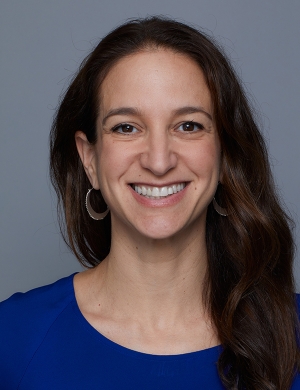 Evidence First host Leigh Parise plays a lead role in MDRC’s education-focused program-development efforts and conducts mixed-methods education research. More